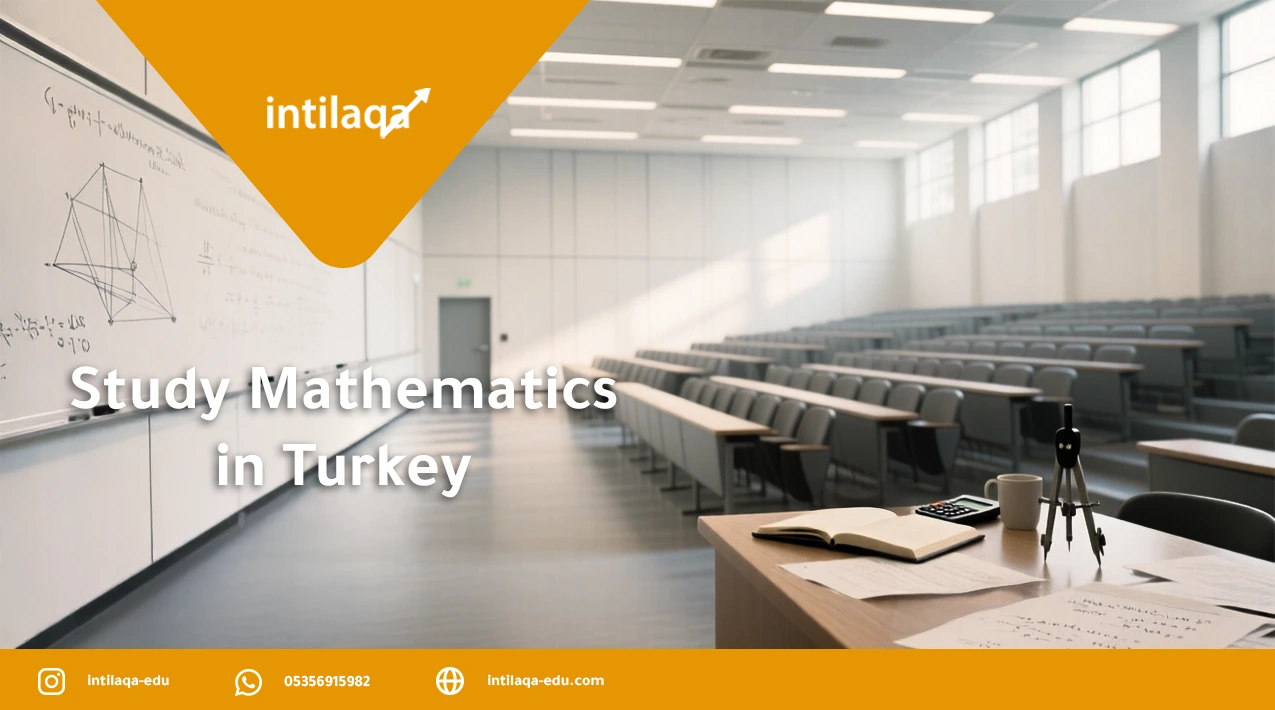
Mathematics transcends the traditional concept of numbers to become the hidden engine of the digital revolution, starting from Artificial Intelligence algorithms to financial market strategies. Herein lies the value to Study Mathematics in Turkey; where universities offer modern curricula integrating deep theories with technical applications, granting you a high competitive advantage at well-considered costs.
In this article, we put a comprehensive guide in your hands: reviewing the best research universities, fee structure, and admission requirements, so you can embark on a flexible and highly demanded career path globally.
Overview of the Mathematics Major
Scientists call mathematics the “mother of sciences” or the “language of the universe.” It is not merely numbers and equations, but the logical foundation upon which all modern sciences are built. Here are the most important points summarizing the essence of this major:
Cornerstone of Sciences:
Mathematics is considered the fundamental pillar upon which physics, engineering, and modern technology majors are built.
Developing Mental Skills:
The major aims to equip the student with deep analytical thinking skills, the ability to solve complex problems, and deduce logical models to explain phenomena.
Keeping Pace with the Digital Age:
Mathematics is no longer limited to academic teaching, but has become the main nerve for vital fields such as Artificial Intelligence, data analysis, cryptography, and financial markets.
Excellence in Turkey:
To Study Mathematics in Turkey is a strategic choice; where universities here integrate established classical theories with contemporary technological applications, granting graduates broad opportunities in the global job market.
Advantages of Studying the Mathematics Major in Turkey
Turkish universities hold a prestigious position in teaching basic and engineering sciences, making the choice to Study Mathematics in Turkey a preferred option for international students seeking academic quality and appropriate cost. Here is what most distinguishes this major in Turkey:
Quality of Education and Academic Staff:
Turkish universities include an elite group of professors and researchers possessing global expertise, and adopt curricula keeping pace with the latest mathematical theories and their modern applications.
Connecting Theory and Technology:
Study programs are not satisfied with abstract theories, but focus heavily on applied mathematics, data science, and programming, qualifying the student for the modern technical job market.
Studying in English:
Many public and private universities offer mathematics study programs entirely in English, breaking the language barrier for foreign students and facilitating their engagement in global research.
Student Exchange Programs (Erasmus):
Being a member of the European Higher Education Area, Turkey grants the student the opportunity to study a semester or a full year at a European university, enriching their academic and cultural experience.
Internationally Accredited Degrees:
Turkish universities follow the “Bologna Process” standards for higher education, meaning the degree the student obtains is recognized in European Union countries and most countries of the world.
What are the Courses of the Mathematics Major in Turkey?
The Study of Mathematics in Turkey features a gradual methodology starting from solid foundations to complex theories and modern applications. The study spans 4 years, and courses are distributed to ensure the student builds a strong knowledge base before moving to precise specializations. Here is the most common course distribution in Turkish universities:
First Year: Foundation Phase
In this year, the student focuses on basic mathematical tools and supporting sciences:
- Calculus I & II: Studying limits, differentiation, and integration and their applications.
- Analytic Geometry: Understanding geometric shapes using algebraic equations.
- Discrete Mathematics: Introduction to mathematical logic and set theory.
- General Physics: To understand how to apply mathematics to natural laws.
- Introduction to Programming: Often Python or C++ is taught to enable the student in computational processing.
Second Year: Deepening in Theories
Here the student begins to enter the core of the abstract mathematical major:
- Linear Algebra: Studying matrices, vectors, and vector spaces.
- Differential Equations: Learning how to model changes in physical and engineering systems.
- Real Analysis: Rebuilding calculus theories but with rigorous and precise mathematical proofs.
- Probability Theory: Studying probability distributions and stochastic processes.
Third and Fourth Year: Specialization and Applications
In the final years, the student chooses their precise track, and courses become more specialized:
- Abstract Algebra: Studying groups, rings, and mathematical fields.
- Complex Analysis: Studying functions dependent on complex numbers.
- Numerical Analysis: Using computational algorithms to solve complex mathematical problems that cannot be solved manually.
- Topology: Studying properties of shapes that remain invariant under deformation (like stretching or bending).
- Advanced Elective Courses: Such as Cryptography, Financial Mathematics, and Artificial Intelligence (AI).
Duration of Studying Mathematics in Turkey
The official duration for the program to Study Mathematics in Turkey is 4 academic years, usually distributed across 8 semesters.
It is worth noting that this duration may extend to become 5 years if the student has to study a “Preparatory Year” to master the language (whether Turkish or English) before starting the major, to ensure the student can accurately comprehend the scientific curricula.
Studying a Master’s in Mathematics in Turkey
Joining Master’s programs in mathematics in Turkey constitutes a qualitative leap toward professional specialization and diving into the depths of scientific research. Turkish educational institutions, through their modern study plans, seek to form cadres of capable researchers and Mathematical Analysts, equipping them with an arsenal of logical and technical skills ensuring them a leading position in both academic and career arenas globally.
Studying mathematics in Turkey for a Master’s degree typically takes 2 years (four semesters). Turkish universities offer the following two tracks with high flexibility:
Master’s with Thesis (Tezli)
This track primarily focuses on original scientific research and preparing an in-depth scientific thesis (dissertation) relying on proof and deduction. This option is considered ideal for students aspiring to pursue PhD studies or work in the academic field, or in scientific and technological research centers. Students can focus in their research (thesis) on precise fields such as:
- Abstract Algebra and Number Theory.
- Differential Equations and Dynamical Systems.
- Topology and Geometry.
- Functional and Complex Analysis.
Non-Thesis Master’s (Tezsiz)
This track is common and specifically designed for professionals, teachers, or those working in the tech and finance sectors. It focuses on the advanced applied and professional aspect, where the student completes intensive coursework and accomplishes a practical “graduation project” (instead of a thesis). This track targets experts seeking to enhance their computational skills and employ mathematics in solving realistic problems in fields such as:
- Financial and Actuarial Mathematics.
- Data Science and Applied Statistics.
- Cryptography and Information Security.
- Operations Research and Optimization.
Studying a PhD in Mathematics in Turkey
The PhD stage crowns the student’s scientific path, where the Study of Mathematics in Turkey elevates at this level from mere academic achievement to the stage of innovation and theory creation. The mission of these programs revolves around forming an elite group of scientists capable of leaving a distinct scientific mark, by addressing intractable mathematical problems and presenting innovative proofs and solutions unprecedented by anyone.
Turkish universities are distinguished by providing a fertile research climate supported by international academic partnerships, making it easier for researchers to engage in the global scientific community and publish their papers in peer-reviewed journals.
This research journey spans on average for 4 years, and the specialized tracks within it usually branch into two main directions:
Pure Mathematics Track:
This track focuses on the purely theoretical and abstract aspect, where the researcher delves into building theories and proving them without necessarily looking at their direct applications. This track is considered the foundation for the work of academics in universities and theoretical research centers. Precise fields in this track include:
- Algebraic Geometry and Topology.
- Harmonic Analysis.
- Number Theory and Elliptic Curves.
- Mathematical Logic.
Applied Mathematics Track:
This track combines mathematical strength with real-world problems. It is designed for researchers wishing to employ mathematical theories to solve challenges in medicine, engineering, technology, and economics. This track opens doors to work in Research and Development (R&D) departments in major companies. Precise fields here include:
- Mathematical Modeling and Simulation.
- Biomathematics to study the spread of diseases and genes.
- Scientific Computing and Algorithms.
- Game Theory and Decision Making.
Best Universities to Study Mathematics in Turkey
When making the decision to Study Mathematics in Turkey, the student looks for universities providing an advanced research environment and English-language curricula keeping pace with technology. Here is an elite selection of distinguished private universities in this field:
Atilim University:
Atilim University is renowned for its strength in scientific research and global rankings (like the Times ranking), making it an excellent choice for students desiring a serious academic environment and advanced laboratories.
Bahcesehir University:
Bahcesehir University is known for its strong international relations and its focus on “applied mathematics” and data science, allowing students practical training opportunities in major tech companies.
Istinye University:
Istinye University is distinguished by its modern technological infrastructure, offering curricula connecting mathematics with Artificial Intelligence, qualifying the student for the jobs of the future.
Bilgi University:
Bilgi University enjoys a prestigious academic reputation and provides an educational environment encouraging critical thinking and logical analysis, making it ideal for students seeking academic excellence.
Halic University:
Halic University offers an education balancing quality and cost, with a major focus on continuous curriculum development to suit the requirements of the digital age.
Cost of Studying Mathematics in Turkey
The cost to Study Mathematics in Turkey varies depending on specific criteria, most importantly the chosen language of instruction, and the strength of the digital infrastructure and computer labs the university provides for students, creating a diversity of options suiting different budgets. Below is a breakdown of the average costs in private universities:
Bachelor’s Level (Annual Fees)
Annual tuition fees for studying mathematical sciences in most private universities range approximately between $4,000 and $11,000. The cost is usually higher for programs taught in English, or in universities providing an advanced technical environment for teaching applied mathematics and programming.
Master’s Level (Full Program)
In postgraduate studies, Turkish universities adopt the payment system for the full program rather than annually. For a Master’s in Mathematics, the total cost ranges between $3,500 and $9,000. This variation is due to the university’s scientific status in research circles, and the quality of the academic staff supervising the research.
PhD Level (Full Program)
Given that a PhD is a long research journey requiring intensive academic supervision and access to global databases, the cost for the entire program (for 4 years) typically ranges between $5,000 and $20,000 in private universities, and may exceed that in universities with a high global ranking offering exceptional research opportunities.
Admission Requirements to Study Mathematics in Turkey
Admission procedures in Faculties of Sciences and Arts are characterized by smoothness. Requirements vary according to the academic degree, but they converge on one goal: ensuring the student’s academic competence and logical thinking ability. Below is a detailed presentation of the basic application requirements:
1. Bachelor’s Level Requirements
This stage is considered the cornerstone for building a mathematical mindset, and it requires:
- High School Diploma: Submitting the original copy of the high school diploma. It is worth noting that private Turkish universities accept all branches (Scientific, Literary, and others) to study mathematics, although scientific preference is always for the student coming from a scientific background.
- Academic Average: The minimum admission threshold varies from one university to another, but in private universities, the minimum limit for admission is typically passing with an average of 50% or 60%, as “astronomical” averages are not required as is the case in medical faculties.
- Language Condition: To join the English track, a valid (TOEFL) certificate must be presented or the university’s own “language proficiency exam” must be passed. For studying in Turkish, a (TÖMER) certificate must be submitted.
- Required Documents for Registration: Translation and notarization (Noter) of the high school diploma and transcripts, a valid passport copy, and biometric personal photos.
2. Master’s Level Requirements
This stage aims to hone research skills and delve into precise branches:
- Previous Qualification: Obtaining a Bachelor’s degree in the major of “Mathematics,” “Statistics,” “Physics,” “Engineering,” or similar quantitative majors.
- Cumulative GPA: A minimum university GPA of no less than 2.00 out of 4.00 is often required (the number may vary slightly depending on each university’s internal regulations).
- Language Proficiency: Proving mastery of the language of instruction (whether English or Turkish) or undergoing a linguistic preparatory year before starting.
- Required Documents for Registration: A passport copy, a translated and notarized copy of the university graduation document and transcripts, and a language certificate if available.
3. PhD Level Requirements
This stage features academic rigor and requires long-term research endurance:
- Previous Qualification: Holding a Master’s degree in mathematics or related applied sciences. Universities give priority to students holding a Master’s under the “Thesis” (Tezli) system to guarantee their research experience.
- Academic Excellence: Achieving a high cumulative GPA in the Master’s stage, where it is usually required not to fall below 2.5 out of 4.00 for file acceptance.
- Foreign Language: Mastery of English is considered a pivotal condition in most PhD programs (even those taught in Turkish) to enable the researcher to review scientific papers and global references.
- Research Plan: Submitting a “Research Proposal” identifying the mathematical or theoretical issue the student aspires to work on or develop during their study years.
- Required Documents for Registration: Master’s degree and transcripts (translated and notarized), an electronic or paper copy of the Master’s thesis, the research proposal, recommendation letters from previous supervisors, and a passport copy.
Career Fields for Mathematics Major Graduates in Turkey
Career paths for this major are not limited solely to the education sector, but multiply to include vital sectors relying on analysis and numbers. The Study of Mathematics in Turkey qualifies students to possess logical and programming skills making them highly demanded in the global job market.
Here are the most prominent jobs and fields available to graduates:
Data Analysis and Artificial Intelligence (Data Science):
Working on processing big data and building predictive models, which is currently the fastest-growing field.
Financial and Banking Sector:
Working as a financial analyst, or an expert in investment risk management, or in stock exchanges and banks.
Cryptography and Information Security:
Using mathematical algorithms to protect digital data and develop Cybersecurity systems.
Programming and Algorithm Development:
Mathematics is considered a foundation for building complex software and search engines.
Academic and Research Field:
Pursuing postgraduate studies and working in research centers or university teaching.
Economics and Actuarial Sciences:
Working in insurance companies to calculate risks and determine benefits and future plans.
How Do I Study Mathematics in Turkey?
To ensure a correct start in the journey to Study Mathematics in Turkey, you must follow measured steps that guarantee your admission to the university most appropriate for your goals. Here is the roadmap:
1. Identifying Appropriate Options
The first step is choosing the university that possesses an academic environment serving your ambition (advanced computer labs, research centers, and a strong teaching staff). Instead of random searching and distracting yourself, you can contact us to nominate the universities distinguished in basic sciences and meeting your scientific aspirations.
2. Preparing the Official File
Begin preparing your essential documents systematically: you will initially need a translated and notarized copy of the high school diploma (transcripts), in addition to a clear copy of your valid passport and recent personal photos.
3. Consulting Experts (Search and Admission)
To save time and guarantee the best option, rely on the “Intilaqa” team. We are here to help you in the search phase and suggest the most appropriate university for you academically and financially, then we handle submitting your file to guarantee you obtain admission with the best available discounts completely for free.
4. Securing Your Academic Seat
Once your documents are submitted, you will receive the “Initial Acceptance Letter” from the university within days. The next step is paying the first installment of tuition fees directly to the university’s account to officially secure your enrollment and obtain the “Final Acceptance Letter”.
5. Obtaining a Student Visa
Take the final acceptance letter to the Turkish embassy or consulate in your country of residence to begin the procedures for obtaining the study visa, which is the official document allowing you to enter Turkish territory as a university student.
6. Arrival and Starting the Journey
Welcome to Turkey! Upon your arrival, we will be waiting to help you complete the final registration procedures on campus and receive your university card, immediately after which you will begin your scientific journey in the world of numbers and logical analysis.
How Does the Intilaqa Team Help You?
The Intilaqa Educational Team works to assist you step-by-step to choose the most appropriate major and university for you in Turkey, according to your academic interests and study budget.
We offer you a comprehensive free consultation that includes:
- Recommending the best Turkish universities that teach your major.
- Clarifying available costs and scholarships.
- Full follow-up in the registration process until final acceptance.
Whether you plan to study Mathematics in Turkey or any other major, you can start by learning about the details of Studying in Turkey via our complete guide:
Study in Turkey