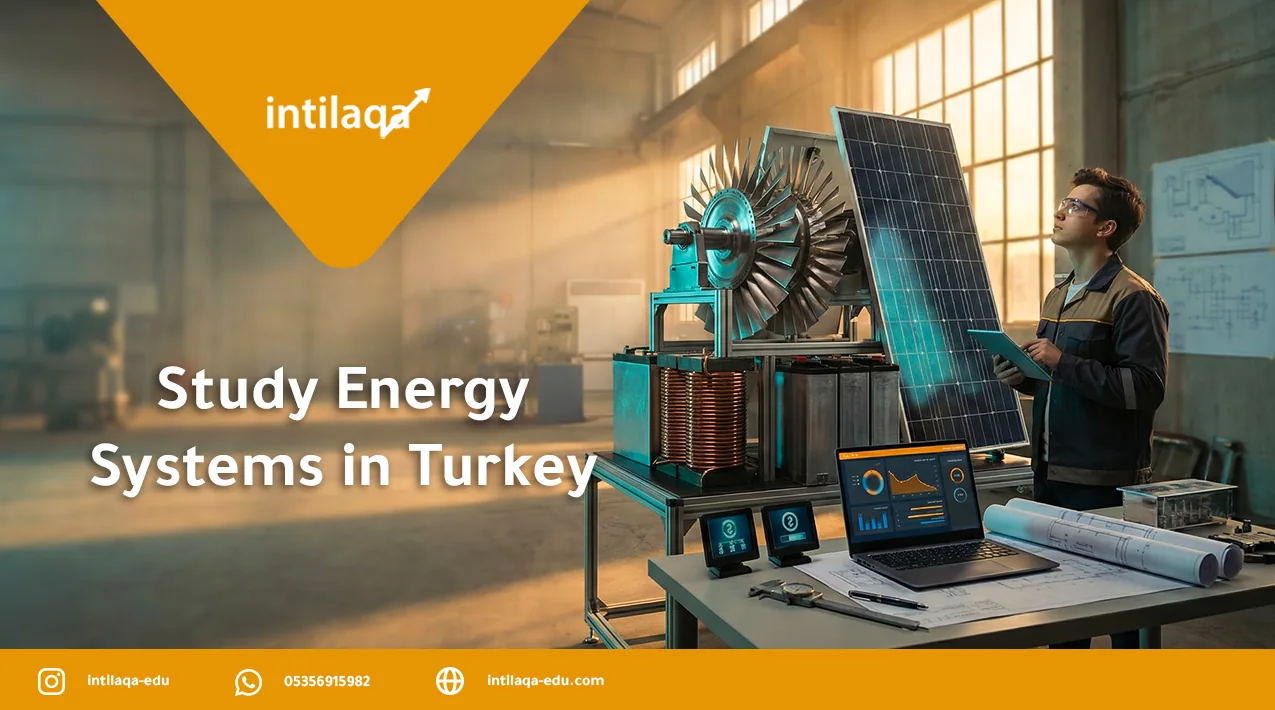
Energy systems engineering is considered the driving nerve for smart cities and modern industries, transcending being merely a traditional major to become a global strategic necessity. Hence, the decision to Study Energy Systems Engineering in Turkey represents an ideal step; where academic programs are designed to graduate engineers possessing sustainable solutions supported by intensive practical training.
We put this integrated guide in your hands to save you the trouble of searching; as we review the best universities, fees, and career prospects.
What is the Energy Systems Engineering Major?
The Energy Systems Engineering major serves as the driving nerve of the modern industrial and technical revolution. It is a multifaceted major that masterfully combines the principles of mechanical engineering, electrical engineering, and environmental sciences. This major aims to find sustainable solutions to generate, transmit, and distribute energy with the highest possible efficiency.
When you Study Energy Systems Engineering in Turkey, the student discovers that this field is not limited only to electricity production, but expands to include designing and managing systems that convert natural resources into useful energy, with a major focus on the global shift toward renewable energy and gradually moving away from traditional polluting sources.
This major is based on several key axes that make it a major of the future:
Renewable Energy Development:
Delving deeply into the study of Renewable Energy technologies and how to exploit natural resources like the sun, wind, and geothermal heat to generate clean energy.
Energy Efficiency:
Studying how to reduce waste in energy consumption in buildings and factories.
Energy Economics:
Understanding the economic feasibility of energy projects and their impact on global markets.
Systems Management:
How to connect different energy sources to smart electrical grids.
What is the Difference Between Energy Systems Engineering and Renewable Energy?
Many students face confusion when choosing between these two tracks due to the great similarity in names, but to understand the difference accurately, we can say that the relationship between them is one of “comprehensiveness” versus “precise specialization”.
When making the decision to Study Energy Systems Engineering in Turkey, you are choosing the broader and more comprehensive field (the larger umbrella), while renewable energy engineering is a precise branch focusing on a specific aspect. Here are the fundamental differences:
1. Energy Systems Engineering (Comprehensive and Administrative View):
This major focuses on the entire “energy lifecycle.” The engineer here is not satisfied with only knowing how to generate energy, but studies how to transmit, store, distribute, and raise its consumption efficiency. The systems engineer deals with all sources (fossil fuels, nuclear energy, and renewable energy) and integrates them together into a smart and stable electrical grid.
2. Renewable Energy Engineering (Technical Depth):
This major focuses exclusively on technologies for generating energy from sustainable natural sources (like the sun and wind). Here, a very important point must be noted: The renewable energy engineering graduate is more specialized and deeper in the technical aspect of renewables. They study precise physical and manufacturing details for solar panels or turbines that a systems engineer might not study with the same intensity.
Conclusion: If your goal is to work in Research and Development (R&D) to exclusively manufacture and develop alternative energy technologies, then the Renewable Energy major is the most appropriate and deepest for you. However, if you aspire to manage integrated energy projects, connect power plants to grids, and analyze energy efficiency in major facilities, then the option to Study Energy Systems Engineering in Turkey is the ideal and most flexible choice in the job market.
Advantages of Studying Energy Systems Engineering in Turkey
Choosing the study destination is no less important than choosing the major itself, and Turkey today is considered one of the most prominent strongly rising countries in the global energy sector. Your decision to Study Energy Systems Engineering in Turkey grants you privileges that transcend classrooms, placing you in the heart of a real and advanced work environment.
Here is what most distinguishes studying this major in Turkish universities:
Massive Applied Environment:
Turkey is not just a place for theoretical study; it is an “open workshop.” The country seeks to be an energy corridor between East and West, investing billions in hydroelectric energy projects, wind power plants in the Aegean region, and solar energy projects in the south, meaning real field training opportunities for students.
Quality of Education and Accreditations (MÜDEK):
Turkish universities are keen to continuously update the curricula of this major to keep pace with European standards. Many engineering faculties hold the MÜDEK accreditation (the equivalent of the European EUR-ACE), making your degree strong and globally recognized.
Advanced Infrastructure and Technology:
Turkish universities provide advanced simulation laboratories for energy systems, and specialized labs in thermodynamics and electrical systems, allowing the student to practically apply what they learn.
Studying in English:
Turkish universities realize the global nature of this major, so most strong universities provide programs to Study Energy Systems Engineering in Turkey entirely in English, which breaks the language barrier and makes it easier for the student to engage in the global market later.
Competitive Tuition Costs:
Compared to European and American universities offering the same level of laboratories and accreditations, tuition fees and living costs in Turkey are considered “economical” and highly suitable for international students.
What are the Courses for the Energy Systems Engineering Major in Turkey?
The curricula of Turkish universities in this major are characterized by blending a strong engineering foundation with direct practical application. The study spans 4 years divided as follows:
1. Engineering Foundation Years (First and Second Year)
In this phase, the “engineer’s mindset” is built within the student, equipping them with the necessary scientific tools to understand energy:
- Basic Sciences:
- General Physics (1 and 2).
- Chemistry (General).
- Calculus (1 & 2).
- Linear Algebra and Differential Equations.
- Common Engineering Courses:
- Introduction to Energy Systems Engineering (A comprehensive introductory course).
- Computer-Aided Engineering Drawing (AutoCAD / SolidWorks).
- Programming for Engineering Algorithms (Often Python or MATLAB).
- Material Science.
- Thermodynamics – One of the most important courses in the major.
- Fluid Mechanics.
2. Specialization and In-Depth Years (Third and Fourth Year)
Here the student begins to enter the core of the Study of Energy Systems Engineering in Turkey, where courses transform into precise technical subjects:
- Core Energy Courses:
- Heat and Mass Transfer.
- Renewable Energy Systems (Solar, Wind, Biomass).
- Electromechanical Energy Conversion.
- Power Electronics.
- Fuels and Combustion.
- Advanced Management and Design Courses:
- Energy Economics – How to calculate project profitability.
- Energy Management & Efficiency.
- Power Plant Design.
- Energy Systems Simulation and Modeling.
- Graduation Project – A practical application to solve a real energy problem.
Important Note: Course names may vary slightly between universities, but the scientific content remains constant and in accordance with the standards of the Turkish Higher Education Council (YÖK).
Duration of Study for Energy Systems Engineering in Turkey
The official duration to Study Energy Systems Engineering in Turkey for the Bachelor’s stage is 4 years (8 semesters).
One Preparatory Year is added for language learning (English or Turkish) in case the student does not possess a language proficiency certificate or does not pass the language exemption exam, making the total duration 5 years.
Master’s in Energy Systems Engineering in Turkey
Master’s programs constitute a qualitative and decisive leap in the path to Study Energy Systems Engineering in Turkey. They do not merely repeat Bachelor’s basics, but transport the engineer to a level of professionalism in Modeling and digital simulation techniques. This academic stage aims to prepare researchers and experts capable of innovating unconventional energy solutions and managing complex systems. The study usually takes two academic years (four semesters) divided into two main, flexible tracks:
1. Master’s with Thesis (Tezli) – Research Track
This track places its full focus on systematic scientific research and knowledge production, where the student must prepare a scientific thesis (dissertation) discussing a technical dilemma in depth. This option is the ideal path for students wishing to complete a PhD or work as researchers in Research and Development (R&D) departments. Key subjects and courses in this track:
- Scientific Research Methods and Ethics: To master the methodologies of writing research papers and academic theses.
- Advanced Modeling and Simulation: Using advanced software to simulate the behavior of energy systems before implementation.
- Advanced Thermodynamics: Delving into the laws of energy and analyzing complex thermal systems.
- Applied Engineering Mathematics: Solving complex differential equations related to energy flow.
2. Non-Thesis Master’s (Tezsiz) – Professional Track
This track is specifically designed for practicing engineers and project managers wishing to develop their skills without dedicating time to lengthy academic research. The program focuses on the applied aspect and developing managerial skills, where the student completes intensive courses with a “Graduation Project” analyzing a realistic issue in the market. Key subjects and courses in this track:
- Energy Project Management and Finance: Studying economic feasibility, calculating costs, and evaluating financial risks.
- Energy Auditing and Efficiency: Learning the mechanisms of inspecting factories and buildings to reduce energy waste.
- Energy Policies and Legislation: Understanding international and local laws regulating energy markets and carbon trading.
- Professional Graduation Project: A practical case study applying engineering solutions directly to it.
PhD in Energy Systems Engineering in Turkey
The PhD stage is considered the pinnacle of the academic and technical pyramid in the path to Study Energy Systems Engineering in Turkey, aiming to graduate an elite group of scientists and innovators capable of inventing radical solutions to global energy crises. Turkish universities focus at this stage on creating “research leaders” possessing highly advanced analytical and mathematical tools, qualifying them to hold high academic positions, lead Research and Development (R&D) centers in global companies, or work as strategic consultants in international energy bodies.
PhD study typically lasts for 4 years (8 semesters). To guarantee high research quality, the program is divided chronologically and structurally into two sequential phases, neither of which can be dispensed with:
1. Knowledge Foundation and Competency Exam Phase (Coursework & Proficiency)
This phase constitutes the rigorous gateway before entering the world of independent research. The student undergoes an intensive program of complex engineering and mathematical courses reshaping their analytical capabilities, concluding with a pivotal stage called the “Comprehensive Competency Exam” (Yeterlilik Sınavı) deciding the student’s scientific eligibility to hold the title of “Doctor.” This part is designed to ensure the researcher possesses a solid grounding in modeling and analysis, focusing on advanced courses such as:
- Advanced Engineering Mathematics and Optimization Methods: To build precise mathematical models for systems.
- Advanced Transport Phenomena: Extreme depth in heat and mass transfer.
- Analysis and Design of Sustainable Energy Systems: Studying the integration between different sources with the highest efficiency.
- Artificial Intelligence in Energy Systems: Using algorithms and big data for prediction and response.
2. Original Research and Dissertation Phase (Dissertation Phase)
After successfully passing the competency exam, the researcher transitions to the core of the PhD, where their role shifts from consuming knowledge to producing and innovating it. This track focuses on conducting precise laboratory experiments or digital simulations contributing to bridging a technical gap in the industry. The student is expected at this stage to publish research papers in global peer-reviewed journals (SCI), and prepare a rigorous dissertation offering a new engineering solution. The research compass often steers toward future issues such as:
- Next-Generation Energy Storage Technology: Developing batteries with new chemical properties or hydrogen storage.
- Smart and Flexible Grids (Smart Grids Resilience): Protecting grids from cyberattacks and disasters.
- Carbon Capture, Utilization, and Storage Systems (CCUS): Technologies to reduce industrial emissions.
- Energy Economics and Strategic Modeling: Creating future scenarios for global energy markets.
Best Universities to Study Energy Systems Engineering in Turkey
1. Bahcesehir University
Bahcesehir University is known by the title “A World University in the Heart of Istanbul.” It is distinguished by an Energy Systems Engineering program that focuses strongly on the international dimension and modern technology. The university provides its students with a highly advanced educational environment, offering them the opportunity to benefit from its global network (BAU Global) to explore the latest energy technologies used globally, qualifying its graduates to work in multinational companies.
2. Bilgi University
Bilgi University possesses a unique historical and moral advantage for students of this major; its main campus (SantralIstanbul) was originally the first power generation plant in the Ottoman Empire, transformed today into an educational edifice and energy museum. Studying this major at “Bilgi” means the student studies in the heart of energy history, benefiting from very strong practical curricula focusing on the “learning by doing” motto, making it a highly inspiring environment for engineers.
3. Atilim University
Atilim University in the capital Ankara is considered one of the strongest research universities in Turkey, renowned for its excellence in engineering majors and scientific research. Its Energy Systems Engineering department features massive laboratories and strong research infrastructure, in addition to its proximity to decision-making centers and defense and energy industry institutions in the capital. This opens broad horizons for professional training and applied research for students.
Cost of Studying Energy Systems Engineering in Turkey
The costs of studying this precise engineering major in private Turkish universities are considered a “high investment value” compared to the volume of complex laboratory equipment and technological infrastructure provided to the student.
For the Bachelor’s stage in strong universities teaching this major in English, tuition fees usually range between $7,800 and up to $11,000 annually. This price variation depends on the university’s ranking, the strength of its international partnerships, in addition to the type of partial scholarship the student receives upon registration.
Admission Requirements to Study Energy Systems Engineering in Turkey
Private Turkish universities feature high flexibility and an “open door” policy toward international students, as admission criteria focus on the desire to learn and technical development more than focusing on “impossible” grades. Here is the detailed guide to admission requirements for each academic stage:
1. Bachelor’s Level Requirements
Admission conditions in engineering faculties at private universities are considered accessible and available to most students, including the following points:
- High School Diploma Type: Due to the engineering nature of the major relying on mathematics and physics, it is often required that the high school diploma be from the Scientific Track (or equivalent relevant technical and industrial certificates), to ensure the student’s ability to comprehend the courses.
- Academic Average: Competitiveness here is highly acceptable; most universities are satisfied with a good passing average in high school (often 60% and above) to guarantee file acceptance in the faculty of engineering.
- Language Condition: If you choose to study in English (which is predominant in this major), you are required to submit a (TOEFL) certificate or pass the “exemption exam” held by the university. For the Turkish language, a (TÖMER) certificate is requested or joining the preparatory year.
- Required Documents: An original and translated copy of the high school diploma and transcripts, a copy of the passport, and personal photos.
2. Master’s Level Requirements
To transition to the level of precise specialization in energy systems, the following must be met:
- Academic Background: Absolute priority is given to those holding a Bachelor’s degree in related engineering majors (such as Energy Systems Engineering, Mechanical, Electrical, or Chemical Engineering) or physical sciences.
- University GPA: It is usually required that the graduation average in the Bachelor’s degree is good, with a minimum of 2.00 out of 4.00 (or equivalent) for file acceptance.
- Language Proficiency: A core condition in postgraduate studies; proficiency in the study language (whether English or Turkish) must be proven to guarantee the researcher’s ability to read complex scientific papers and publish in international journals.
- Required Documents: The university graduation certificate and transcripts (translated and notarized), language certificate, and a copy of the passport.
3. PhD Level Requirements
Criteria here feature precision and selectivity, given the nature of the deep research degree:
- Type of Previous Master’s: This is a basic condition; universities require that the Master’s degree be under the “Thesis” (Tezli) system, to ensure the student possesses previous research experience qualifying them for the PhD project. A professional Master’s (Tezsiz) is usually not accepted in this track.
- Academic Merit: The cumulative GPA in the Master’s must be high (no less than 2.50 or 3.00 depending on the university’s ranking) to indicate outstanding scientific competence.
- Foreign Language Mastery: Even in programs taught in Turkish, proving proficiency in a foreign language (like English) is often requested to enable the researcher to access global sources and keep pace with modern technology.
- Research Proposal: Submitting a research project draft explaining the engineering problem you intend to solve and the proposed methodology. This is the deciding criterion for the academic supervisor’s acceptance of your file.
- Required Documents for Registration: A copy of the passport, the Master’s degree and transcripts (translated and notarized), a copy of the previous Master’s thesis, the research proposal, and a language proficiency certificate.
Future of Energy Systems Engineering Graduates
The shift toward clean energy is no longer a luxury choice for countries, but has become an urgent economic and environmental necessity dictated by international agreements, making graduates of this major a rare commodity highly demanded in both global and local markets.
When you choose to Study Energy Systems Engineering in Turkey, you set foot in a sector growing at rocket speed, driven by three main engines guaranteeing you job security for many years:
Renewable Energy Revolution:
Governments and companies are racing to replace traditional fuel plants with massive wind and solar energy farms, creating thousands of opportunities in design, installation, and project management.
Energy Efficiency:
In light of rising fuel prices, major factories and companies are looking for professional engineers to reduce the consumption bill and stop waste, making the systems engineer’s role pivotal in increasing corporate profits.
Smart Cities and Electric Vehicles:
With the global shift towards electric vehicles (EVs), the desperate need increases for engineers capable of designing advanced charging stations and managing smart grids that feed the cities of the future.
How Do I Study Energy Systems Engineering in Turkey?
To ensure a smooth academic start, follow the upcoming roadmap that guarantees you a seat in the best engineering faculties:
1. Choosing a University with Strong Infrastructure
The first and most important step is choosing the university that possesses advanced engineering laboratories and modern simulation labs, as engineering is an application before it is theories. Instead of searching randomly, contact us to provide you with a list of universities featuring industrial partnerships and international accreditations, to guarantee you an education keeping pace with the latest technologies.
2. Preparing the Academic File
Start organizing your documents early to ensure swift procedures. You will basically need an original copy (translated and notarized) of the high school diploma (Scientific Track preferred) with transcripts, in addition to a passport copy (valid) and recent personal photos.
3. Consulting Experts (Intilaqa)
To save your time and guarantee the most appropriate choice, let the “Intilaqa” team handle the mission. We will evaluate your file and recommend the best university for your ambition and budget, then take over the application process on your behalf professionally and entirely for free, while guaranteeing you obtain the highest available discounts and scholarships.
4. Confirming University Enrollment
After applying, you will receive the “Initial Acceptance” document. To secure your seat finally (especially since engineering seats are limited), you must transfer the first installment of tuition fees to the university’s bank account, immediately after which you will receive the “Final Acceptance Letter”.
5. Obtaining a Student Visa
Once you obtain the final acceptance, head immediately to the Turkish consulate in your country to apply for a “Student Visa,” as it is your legal document to enter Turkish territory and reside there for the purpose of study.
6. Arrival and Starting the Journey
Welcome to Turkey! Upon your arrival, we will be waiting for you to guide you in completing the administrative registration procedures on campus and receiving your university card, immediately after which you will start your first steps in this enjoyable major.
How Does the Intilaqa Team Help You?
The Intilaqa Educational Team works to assist you step-by-step to choose the most appropriate major and university for you in Turkey, according to your academic interests and study budget.
We offer you a comprehensive free consultation that includes:
- Recommending the best Turkish universities that teach your major.
- Clarifying available costs and scholarships.
- Full follow-up in the registration process until final acceptance.
Whether you plan to study Energy Systems Engineering in Turkey or any other major, you can start by learning about the details of Studying in Turkey via our complete guide:
Study in Turkey