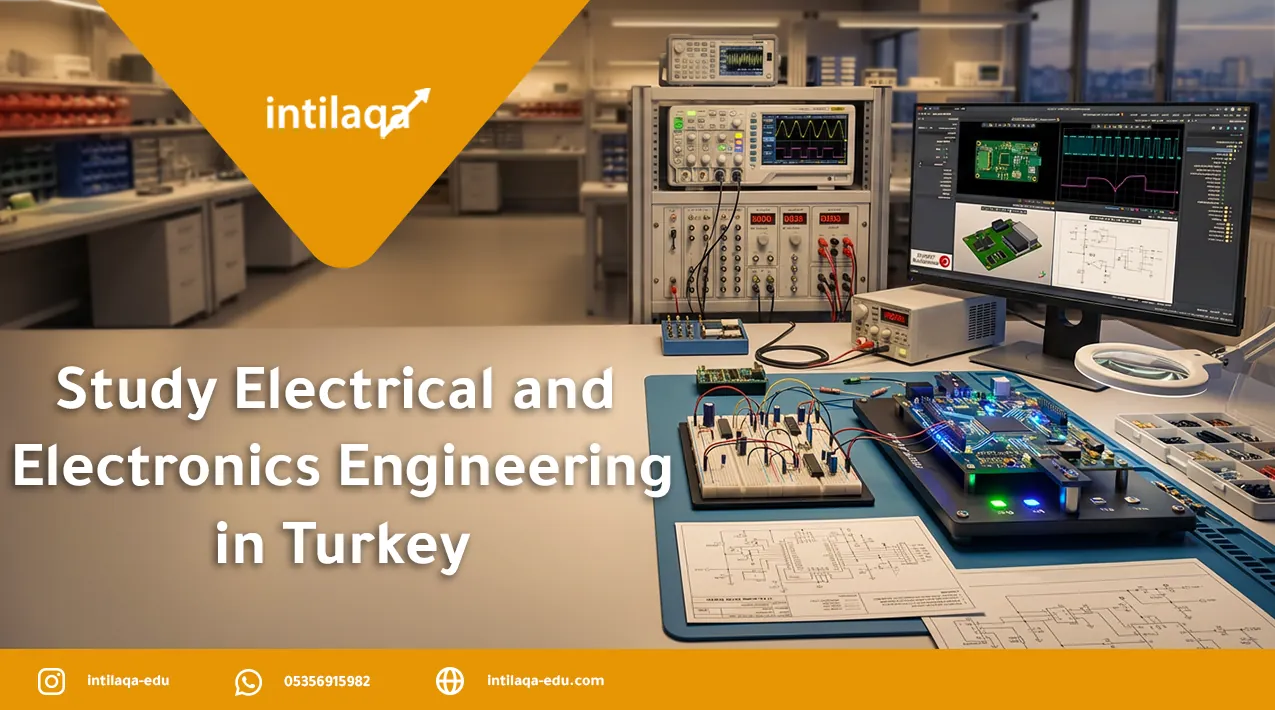
Technology is no longer just a set of helpful tools — it’s the backbone of modern life. And if you aspire to be a builder of this future rather than just a user of it, then study Electrical and Electronics Engineering in Turkey is your ideal gateway.
Turkey stands out for an educational environment that connects theory with practice, benefiting from the country’s industrial and technological boom. Universities provide advanced labs that simulate the realities of the global market, giving students genuine hands-on experience. In this guide, we lay out a complete roadmap covering everything about this major, from the curriculum all the way to promising career opportunities.
What Is Electrical and Electronics Engineering?
This major is the hidden engine behind every aspect of modern life we experience. Studying Electrical and Electronics Engineering in Turkey gives students the chance to dive into the details of this advanced field, focusing on several core areas that include:
Power Generation and Management:
Focusing on designing smart grids to distribute electricity with minimal loss, and integrating renewable energy sources such as solar and wind to ensure sustainable energy for cities.
Developing Smart Technology:
Working on designing microprocessors and integrated circuits that serve as the “brains” of devices, intelligently powering everything from phones to medical equipment.
Communications and Data Transmission:
Developing network infrastructure such as 5G and fiber optics, to ensure safe and fast transmission of data and information around the world.
Automation and Control:
Designing smart systems to manage factories, a field that closely integrates with Industrial Engineering; engineers work together to improve production line efficiency and reduce human error.
This way, students build a solid knowledge base and practical skills that qualify them to play an active role in leading technological and industrial development in the future.
Advantages of Studying Electrical and Electronics Engineering in Turkey
Why Turkey specifically? Because in recent years it has become a massive regional hub for tech and defense industries. This strong industrial reality is directly reflected in the quality of university education, making the decision to study Electrical and Electronics Engineering in Turkey a strategic choice that puts you at the heart of the tech scene, where theoretical curricula integrate with an advanced applied environment that ensures your excellence — thanks to several factors, most notably:
Advanced Technological Infrastructure:
Turkish universities provide modern labs and simulation facilities that allow students to apply physics and electronics theories directly and practically.
International Accreditations (ABET):
Many engineering programs at Turkish universities hold accreditation from the American ABET, making the degree internationally recognized and easing work or further graduate study abroad.
Connection to the Job Market:
Turkey is home to technoparks and massive defense and electronics industries, giving students real internship opportunities during their studies and direct exposure to major projects.
Studying in English:
Most prestigious universities teach this major entirely in English, removing the language barrier and preparing students to work at global companies.
Student Exchange Programs:
Turkish universities open up global horizons for their students through strong partnerships in the European student exchange program. This golden opportunity is reserved for outstanding students who meet academic excellence requirements, allowing them to study a semester or more at European universities.
Electrical and Electronics Engineering Curriculum in Turkey
The curriculum for study Electrical and Electronics Engineering in Turkey is comprehensive, designed to cover all the theoretical and practical aspects needed to build a capable engineer. Although course names or order may vary somewhat from one university to another, the core scientific content remains the same and covers the following areas:
Foundation and Basic Science Courses
This stage focuses on building the strong scientific and mathematical foundation needed to grasp engineering theories later on.
- Calculus.
- General Physics (Mechanics and Electricity).
- General Chemistry.
- Linear Algebra.
- Introduction to Programming and Algorithms.
Engineering and Electronics Fundamentals
Here, students begin actually entering the core of the major and understanding the basic principles of electricity and circuits.
- Circuit Analysis.
- Analog and Digital Electronics.
- Differential Equations.
- Electromagnetic Fields.
- Probability and Engineering Statistics.
Advanced Technical Specialization Courses
This is the most intensive stage academically, where students delve into advanced techniques, control systems, and microprocessing.
- Signals and Systems.
- Microprocessors.
- Automatic Control Systems.
- Communication Systems.
- Electromechanical Energy Conversion.
Practical Applications and Graduation Project Courses
This group is dedicated to hands-on application and choosing a specific track (power or communications) through elective courses.
- Graduation Project.
- Specialized elective courses (such as: renewable energy, fiber optics).
- Field Training / Internship.
Duration of Electrical and Electronics Engineering Studies in Turkey
The standard duration of a bachelor’s program for Electrical and Electronics Engineering in Turkey is 4 years, divided into 8 semesters.
If a student does not hold a language proficiency certificate (whether studying in English or Turkish), a preparatory year (Hazirlik) is added to learn the language, bringing the total study duration to 5 years.
Master’s in Electrical and Electronics Engineering in Turkey
The bachelor’s stage is the essential foundation for any successful engineer, but to deepen this knowledge and reach leadership positions, pursuing graduate studies becomes the natural next step to refine expertise and move toward specialized focus. Universities here offer two main tracks:
1. Thesis-Based Master’s (Tezli) — Research and Innovation Track
This track is aimed at engineers who want to be part of developing technology rather than just users of it, or those planning an academic career path. Here, students delve deep into theory to produce a “thesis” that contributes to solving technical challenges. Key areas of academic focus include:
- Advanced Systems Analysis: to understand the dynamic behavior of complex systems.
- Advanced Power Electronics: to design highly efficient power converters.
- Nanotechnology and Microelectronics: to enter the world of chip and semiconductor manufacturing.
- Scientific Research Methods: to master experimental tools and academic documentation.
2. Non-Thesis Master’s (Tezsiz) — Professional Development Track
An ideal option for practicing engineers who want to support their hands-on experience with advanced academic knowledge that helps them advance in their careers and manage technical teams. Instead of a research thesis, students complete an “applied project.” Courses here focus on the practical and managerial side, such as:
- Energy and Industrial Systems Management: learning how to manage power plants and production lines economically.
- Modern Communication Systems: learning about network protocols and 5G from an applied perspective.
- Digital Control and Automation: programming industrial controllers (PLC) and smart systems.
- Final Project: solving a real technical problem faced by a company or factory.
PhD in Electrical and Electronics Engineering in Turkey
This stage represents the pinnacle of the academic pyramid, where the researcher transforms from a mere “student” of science into a “creator” of knowledge. PhD programs at Turkish universities aim to prepare an elite group of scientists and researchers capable of leading development teams at major tech companies or holding senior academic positions.
The academic journey for students at Turkish universities follows a strict structure divided into two pivotal stages:
1. The Preparatory Stage and Comprehensive Exam
Before starting research, students must pass a set of highly advanced courses to prove their competence, then go through the “comprehensive exam” (Yeterlilik Sinavi), which tests their ability to understand and connect all aspects of the field. Key areas of advanced study include:
- Smart Control Algorithms and Robotics: studying complex mathematical models to develop self-driving systems.
- Advanced Integrated Circuit (VLSI) Design: techniques for designing chips containing billions of transistors.
- Wireless Sensor Networks: developing protocols to connect thousands of devices within Internet of Things (IoT) networks.
- Philosophy of Science and Research Methods: to learn the foundations of critical thinking and building scientific hypotheses.
2. The PhD Dissertation (Originality and Innovation)
This is the essence of the PhD; repeating what already exists is not accepted. The researcher must present an “Original Contribution” that did not exist before, whether through inventing a new algorithm, an unprecedented improvement in the efficiency of an energy system, or registering a patent.
- The student must publish several research papers in peer-reviewed international scientific journals (SCI/SCI-E) as a core graduation requirement.
- The dissertation is defended before a jury committee of senior professors to assess its added scientific value.
Best Universities for Studying Electrical and Electronics Engineering in Turkey
Turkey is home to a group of distinguished universities that offer an advanced educational environment and modern simulation labs. The following names stand out as the top options available when studying Electrical and Electronics Engineering in Turkey:
Istanbul Aydin University:
Istanbul Aydin University stands out for its advanced “Technopark” labs that allow engineering students to apply their hands-on projects, and it has strong partnerships with the industrial sector, offering excellent internship opportunities.
Bahcesehir University:
Bahcesehir University is known for its “CO-OP” program, which directly links university education to the job market, where electrical engineering students collaborate with major global companies during their studies to develop real-world technical solutions.
Atilim University:
Atilim University is considered one of the strongest research universities in Turkey, with a strong focus on aerospace and defense engineering, giving electronics students the chance to work on advanced research projects in these sensitive fields.
Topkapi University:
Topkapi University focuses on the applied, professional side, offering engineering students a flexible learning environment and modern curricula that keep up with local market demands, with special attention to developing core technical skills.
Istanbul Gelisim University:
Gelisim University holds numerous international accreditations (ABET) for its engineering programs, ensuring the quality of education in electrical and electronics engineering and its compliance with rigorous global standards.
Halic University:
Halic University stands out for its historic location and curricula that blend theory and practice, and it focuses on producing engineers proficient in electronic design tools and modern digital systems.
Cost of Studying Electrical and Electronics Engineering in Turkey
University fees vary depending on several factors, most importantly the university’s ranking and the language of instruction. Looking at the cost of studying Electrical and Electronics Engineering in Turkey, this major requires advanced technological infrastructure and modern simulation labs, which is directly reflected in tuition fees that cover the cost of this educational quality. Below are the average prices:
Bachelor’s Stage (Annually)
Given the technical nature of the major and students’ continuous need to use labs and expensive electronic components, annual fees at private universities start at around $2,500 and go up to $11,000. Prices tend to be higher in programs offered in English, especially at universities with international accreditations and external partnerships.
Master’s Stage (Full Program)
Whether you choose the academic track (thesis) or the applied professional track, the total program cost starts at $2,250 and goes up to $10,000. The price variation depends largely on how modern the research labs are and the technical resources the university makes available to researchers in the fields of power and communications.
PhD Stage (Full Program)
At this advanced stage, which requires original research and precise experiments in fields such as artificial intelligence and chip design, the full program cost starts at $3,000 and goes up to $15,000. Fees may be higher at elite universities with advanced R&D centers and major technology partnerships.
Admission Requirements for Electrical and Electronics Engineering in Turkey
Private Turkish universities follow a smooth admission policy that supports international students, steering away from routine administrative complications and instead focusing on scientific passion and a desire for technological innovation. Below is a detailed breakdown of the admission requirements and necessary documents for each academic stage when applying to study Electrical and Electronics Engineering in Turkey:
1. Bachelor’s Stage Requirements
Admission criteria for engineering faculties are clear, and can be summarized in the following key points:
- Academic Background: Since electrical and electronics science relies entirely on physics and computational processes, the high school diploma must be from the science track (or an equivalent industrial/technical certificate), to ensure students have the necessary foundational knowledge.
- Required GPA: Private universities offer wide admission opportunities; a good passing grade in high school (starting from 60% and above) is usually sufficient to secure a seat.
- Language Requirement: Students cannot follow complex lectures without language proficiency. An accredited language proficiency certificate must be submitted, or students must pass the university’s “exemption exam.” If unsuccessful, the student joins a language preparatory year.
- Required Documents: Passport copy, transcript, high school diploma (translated and certified), and personal photos.
2. Master’s Stage Requirements
To move toward specialized focus and advanced research, the following criteria must be met:
- Previous Major: Absolute priority is given to holders of a bachelor’s degree in directly related majors (such as Electrical Engineering, Electronics, Communications, Computer Engineering, or Mechatronics).
- Cumulative GPA: The bachelor’s graduation GPA must be acceptable, with a minimum of 2.00 out of 4.00 (or its equivalent) for the academic file to be accepted.
- Language Proof: Submitting a document proving proficiency in the language of instruction (English or Turkish) is a basic requirement for final registration, or the student enters a language preparatory year.
- Required Documents: Passport copy, bachelor’s degree certificate and transcript (translated and certified), language certificate, and personal photos.
3. PhD Stage Requirements
The criteria at this stage are more rigorous and selective, as it is an advanced research degree:
- Type of Master’s Degree: This is the essential requirement; universities only accept students who hold a thesis-based (“Tezli”) master’s degree, as this demonstrates prior research experience and academic writing skills.
- Academic Excellence: A high cumulative GPA at the master’s stage is required (usually no less than 2.50 or 3.00) as clear evidence of academic competence.
- Foreign Language Requirement: A high level of proficiency in a foreign language (such as English) is usually required through standardized tests (such as TOEFL or YDS), even in programs taught in Turkish, to enable researchers to keep up with the latest international scientific papers.
- Research Proposal: Submitting an initial draft explaining the technical or engineering problem the student intends to address — the main criterion the academic advisor uses to approve the student’s acceptance.
- Required Documents: Passport copy, master’s degree certificate and transcript (translated and certified), a copy of the previous master’s thesis, language certificate, research proposal, and personal photos.
Career Future for Electrical and Electronics Engineering Graduates
With the growing reliance on technology in all aspects of life, graduates of this major find diverse career paths across many industrial and service sectors. Studying Electrical and Electronics Engineering in Turkey qualifies students to work in several technical fields, including:
Power Engineering:
Working at power generation plants and distribution companies, as well as participating in planning and executing renewable energy projects (solar and wind) to ensure efficient electricity supply.
Telecommunications Sector:
Working with telecom and internet service providers on installing and maintaining infrastructure, such as transmission towers and fiber optic networks, to ensure stable connection quality and data transmission.
Electronics Design:
Here, the engineer handles designing and testing electronic circuits and printed circuit boards (PCBs) used in manufacturing medical devices, smartphones, and industrial equipment.
Industrial Control and Automation:
Working inside factories to program automatic control systems (PLC) and oversee production lines, aiming to improve process speed and reduce human error rates.
Defense Industries:
Participating in technical teams developing and maintaining precise electronic systems, such as radar devices, navigation systems, and remote sensing equipment.
Embedded Systems:
Programming small smart systems that run inside machines, modern cars, and home appliances, enabling them to perform specific functions with high precision.
How Do I Study Electrical and Electronics Engineering in Turkey?
To make the enrollment process easier for you, and to ensure an academic experience that meets your ambitions and suits your abilities, we’ve summarized the path into clear, practical steps — from choosing your program to sitting in the classroom:
1. Choosing the Right University
This is the most important step; focus when choosing on universities that offer modern technical labs and strong infrastructure that serves your major, while considering international accreditations and how well the tuition fits your budget — something we help you pinpoint precisely to ensure you make the best choice.
2. Preparing the File and Official Documents
Start preparing your documents early to speed up the process and avoid delays. You’ll mainly need: your high school diploma (science track) translated and certified, transcript, a copy of a valid passport, and personal photos.
3. Consulting the Experts (Intilaqa)
Instead of second-guessing yourself and wasting time searching, let the Intilaqa team shorten the path for you. We’ll review your file and suggest the options best suited to your grades, handle the entire application process for free, and make sure you get admitted while following up on any available scholarships and discounts.
4. Confirming Preliminary Enrollment
After submitting your application and receiving “preliminary acceptance,” you’ll need to transfer the first tuition installment to the university’s account to secure your seat officially, after which you’ll immediately receive “final acceptance.”
5. Obtaining the Student Visa
Once you have your final acceptance letter, go directly to the Turkish embassy or consulate in your country to apply for a “student visa.” This step is necessary and legally required to enter Turkish territory and reside there for study purposes.
6. Arrival and Starting Your Studies
Welcome to Turkey! Upon your arrival, we’ll be right there with you to guide you through completing administrative registration at the university and receiving your student ID, after which you’ll immediately begin your academic journey.
How Can the Intilaqa Team Help You?
The Intilaqa Education team works to help you step by step choose the right major and university for you in Turkey, according to your academic interests and study budget.
We offer you a comprehensive free consultation that includes:
- Recommending the best Turkish universities that teach your major.
- Clarifying the costs and scholarships available.
- Full follow-up throughout the enrollment process until final acceptance.
Whether you’re planning to study Electrical and Electronics Engineering in Turkey or any other major, you can start learning about the details of studying in Turkey through our complete guide:
Studying in Turkey