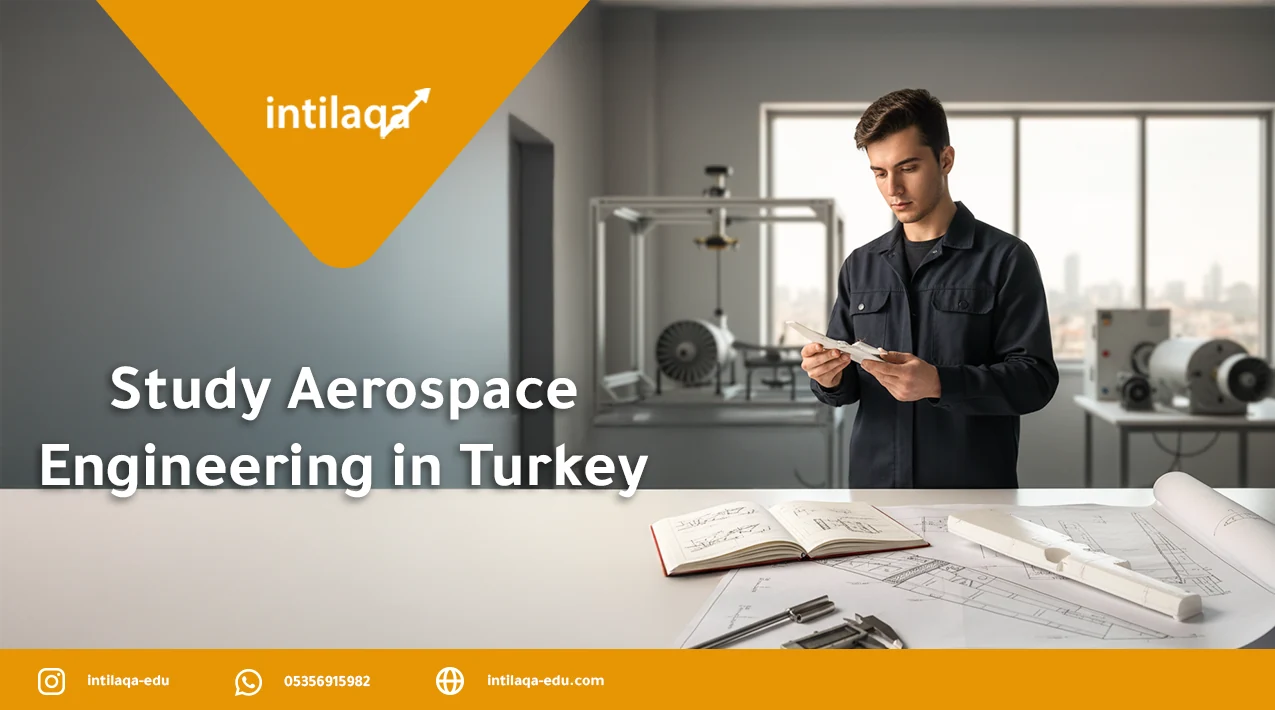
The decision to Study Aerospace Engineering in Turkey transcends traditional theories to place you at the heart of the drone technology and defense industries revolution. In this guide, we provide you with a roadmap to choose universities offering advanced laboratories and field training that guarantee you a promising professional future.
What is the Aerospace Engineering Major?
The Aerospace Engineering major in Turkey is considered one of the most prestigious engineering branches that merge technical innovation with precise physical sciences. It is the science directly responsible for converting physical theories into vehicles capable of flying safely within the Earth’s atmosphere.
This major is based on several key areas that the student studies and later practices:
Design and Construction:
Innovating the structures of commercial aircraft, military aircraft, and helicopters to ensure lightweight and durability.
Aerodynamics:
Studying air movement around the aircraft body to reduce resistance and increase flight speed and efficiency.
Propulsion Systems and Engines:
Developing and maintaining jet and turbine engines that generate the power necessary for flight.
Control and Stability Systems:
Programming and designing electronic systems that ensure the aircraft’s balance and responsiveness to commands.
Relationship Between Aeronautical Engineering and Astronautical Engineering: It is important to note the significant scientific intersection between this major and the Astronautical Engineering major. Both share mathematical and physical foundations and materials science, making the transition between the two fields or merging their expertise accessible and required in massive engineering projects.
What are the Differences and Similarities Between Aeronautical and Astronautical Engineering?
These two fields are often confused or merged together, as is the case in many Aerospace Engineering major programs in Turkey that adopt the title “Aerospace Engineering.” However, to understand the nature of the study, the fundamental points of intersection and difference must be clarified:
First: Similarities (Academic Strength Point)
Both majors share the foundational scientific base, where the curriculum in the first years overlaps by up to 70-80%. The similarities include:
- Materials Science: Studying metals and composite materials capable of withstanding high pressure and heat.
- Propulsion Systems: The basic principles of engines (whether jet or rocket).
- Control Systems: How to guide the vehicle and stabilize it, whether in the air or space.
- Design Software: Using the same advanced engineering software (such as CAD and ANSYS).
Second: Fundamental Differences (Work Environment)
The main difference lies in the “medium” in which the vehicle operates, which radically changes the design equations:
1. Aeronautical Engineering:
- Environment: Operates exclusively within the Earth’s atmosphere.
- Principle: Relies entirely on air to generate the “Lift” necessary for flight.
- Applications: Commercial aircraft, military aircraft, helicopters, and unmanned aerial vehicles (UAVs).
2. Astronautical Engineering:
- Environment: Operates in the outer vacuum (Space) outside the atmosphere.
- Principle: Does not rely on wings or air, but relies on “Orbital Dynamics” and rocket propulsion to move in a vacuum.
- Applications: Rockets, space stations, satellites, and planetary probes.
Advantages of Studying the Aerospace Engineering Major in Turkey
Why do international students choose Turkey specifically for this precise field? The answer lies in the fact that Turkey is no longer just a country that teaches this science, but has become a major player in the world of modern Aviation. Studying the Aerospace Engineering major in Turkey grants you the opportunity to be at the heart of a true technological revolution. Here are the most prominent advantages:
1. Leading Industrial Environment (The Drone Era):
Turkey is currently distinguished by massive progress and a global ranking in the Unmanned Aerial Vehicles (UAVs) industry and national projects like the fighter jet (KAAN). This growth means the student studies in a vibrant environment, with training opportunities available in giant companies like (TUSAŞ) and (BAYKAR).
2. Quality of Education and International Accreditations:
Turkish universities offer updated curricula keeping pace with global standards, where this major is taught in most prestigious universities entirely in English. Additionally, many programs possess international accreditations (like ABET or MÜDEK), facilitating degree equivalency and working with it in Europe and America.
3. Infrastructure and Simulation Laboratories:
Study is not limited to books; Turkish universities include workshops, Wind Tunnels, and flight simulators. Some university campuses contain real aircraft and jet engines for students to practice assembling and disassembling them practically.
4. Technology Festivals (Teknofest):
Turkey annually hosts the world’s largest aviation and space technology festival (Teknofest). This event allows engineering students to form teams, design their own aircraft, compete with them, and present their innovations directly to major companies and investors.
5. Appropriate Economic Cost:
Compared to the high quality of education and advanced infrastructure, the tuition fees for studying this major in “private” Turkish universities are considered low and very reasonable compared to their counterparts in Europe and the United States.
What are the Courses for the Aerospace Engineering Major in Turkey?
The study plan in Turkish universities is characterized by a logical progression from pure sciences to complex engineering application and design. When you Study Aerospace Engineering in Turkey, you will pass through the following academic stages covering all technical aspects:
Foundation Stage (Basic Sciences):
This stage focuses on building a solid base in mathematics and physics, which is the cornerstone for any engineer:
- Calculus.
- General Physics and Chemistry.
- Introduction to Aerospace Engineering.
- Computer Programming: Learning programming languages (such as MATLAB or Python) and employing them to solve engineering equations.
- Technical Drawing.
Engineering Core Stage:
Here, the student begins studying the mechanics of materials and energy, the subjects that physically explain how machines work:
- Thermodynamics.
- Fluid Mechanics – Considered a core subject.
- Statics & Dynamics.
- Strength of Materials.
- Differential Equations.
Precise Specialization Stage:
Considered the most important and intensive stage, delving into the core of aviation sciences:
- Aerodynamics: Studying airflow and its impact on the aircraft.
- Flight Mechanics: Aircraft performance, stability, and control.
- Propulsion Systems: Studying jet and turbine engines.
- Aircraft Structures: Designing the structure to withstand atmospheric pressures.
Design and Application Stage:
Focuses on integrating everything above to produce comprehensive engineering solutions:
- Aircraft Design – Comprehensive theoretical and practical application.
- Automatic Control Systems.
- Avionics.
- Graduation Project: A basic requirement where the student designs a model or solves a complex technical problem.
How Many Years is the Study of Aerospace Engineering in Turkey?
The standard duration to study the Aerospace Engineering major in Turkey is 4 academic years.
A full year called the “Preparatory Year” dedicated to language learning is added if the student is not proficient in the language of instruction (which is mostly English), making the total study duration 5 years. The student can skip this additional year and start immediately in their four years if they provide proof of language proficiency or pass the exemption exam conducted by the university.
Studying a Master’s in Aerospace Engineering in Turkey
Studying a Master’s in this field constitutes a qualitative leap from the stage of “general comprehension” of engineering principles in the Bachelor’s, to the stage of “innovation and precise specialization.” While the Bachelor’s graduates an engineer capable of operation and maintenance, the Master’s aims to create an R&D Engineer capable of innovating new solutions.
Turkish universities at the postgraduate level are distinguished by possessing research centers connected to the defense and aerospace industries sector, granting the student an opportunity to work on real technologies. Master’s study typically takes 2 years (4 semesters), and universities offer two study systems to meet different student needs:
1. Master’s with Thesis (Tezli)
This track is considered the classic academic choice, focusing strictly on scientific research and development. It is the most appropriate track for students planning to complete a PhD later, or those aspiring to work in Research and Development (R&D) departments within aircraft and drone manufacturing companies. This track requires preparing a “Research Thesis” discussing a complex engineering problem, and research often centers around precise topics such as:
1. Computational Fluid Dynamics (CFD):
Using advanced computer software to simulate airflow and its effects on the aircraft body, reducing the cost and need to build physical experimental models.
2. Advanced Composite Materials:
Researching modern materials like carbon fiber, which give the aircraft a lighter weight and higher rigidity to resist pressure and heat compared to traditional metals.
3. Propulsion Systems:
Studying and developing internal combustion technologies in jet engines and rockets to increase thrust and reduce fuel consumption and emissions.
4. Guidance, Navigation, and Control (GNC):
Designing smart algorithms and precise sensor systems that allow aircraft (especially drones) to guide themselves and maintain their course steadily with self-balance, ensuring safety and coordination with Air Traffic Control systems.
2. Non-Thesis Master’s (Tezsiz)
This program is designed to be more flexible and practical, often directed at engineers actually working in the field who wish to upgrade their career path without dedicating time to lengthy academic research. Instead of a thesis, the student completes an applied “Engineering Graduation Project” solving a realistic problem in the work environment. This track aims to raise the technical and managerial competency of the engineer to assume leadership positions in aviation and maintenance companies, focusing on areas such as:
- Aircraft Maintenance Management.
- Systems Integration.
- Engineering Project Management.
- Airworthiness & Aviation Safety.
Studying a PhD in Aerospace Engineering in Turkey
The PhD degree in this major represents the pinnacle of the academic and research pyramid. It is the stage where the student transforms from a “professional engineer” into a “researcher and scientist” possessing the ability to add new theories to science. Turkish universities provide the foreign PhD student with a research environment of global standards, supported by advanced laboratories and massive research funding, qualifying them to work in major global universities and international R&D Centers after graduation.
PhD study typically takes 4 years, and it is a rigorous intellectual journey aiming to build an independent researcher, passing through three pivotal phases:
1. Advanced Coursework Stage:
In the first year, the researcher studies complex theoretical courses and high-level mathematical analyses, aiming to deepen their understanding of physical phenomena and bridge any knowledge gaps they have, to prepare them for the research phase.
2. Comprehensive Competency Exam (Yeterlilik Sınavı):
This is the most important milestone distinguishing a PhD from a Master’s. After completing the courses, the researcher undergoes a precise exam (oral and written) before a panel of senior academics; the goal is not to test memorization, but to ensure their scientific maturity and ability to defend their ideas and convince the panel of their proposed research project.
3. Dissertation and Scientific Innovation:
Here, the researcher dedicates several years to working on a previously unsolved engineering dilemma, or radically developing an existing technology. Turkish universities allow researchers to work on topics keeping pace with the “global trend” in technology, such as:
- Hypersonic Aerodynamics: Studying vehicle behavior at speeds multiple times the speed of sound.
- Applications of Artificial Intelligence in Aviation: Developing algorithms making aircraft capable of autonomously making complex decisions.
- Green Aviation: Innovating electric and hybrid propulsion systems to reduce fuel consumption, a highly demanded field in Europe.
- Miniature Satellite Technology (CubeSats): Designing and developing control and communication systems for low-cost small spacecraft.
Best Universities to Study Aerospace Engineering in Turkey
1. University of Turkish Aeronautical Association (THK University)
This university is considered the “most prestigious and specialized”, as it is the first and only university in Turkey established specifically for aviation and space sciences.
- Its Advantage for the Student: Located in the capital, Ankara, it owns its private airport (Etimesgut Airport) and a fleet of training aircraft, meaning the student lives in a real aviation environment, not just theoretical classrooms.
2. Istanbul Aydin University
Istanbul Aydin University is one of the most attractive universities for international students in Istanbul, renowned for the strength of its engineering faculties and technological laboratories (Technocenter).
- Its Advantage for the Student: It offers the “Aerospace Engineering” program and features extensive partnerships with European universities within the “Erasmus” program, making it easy for the student to spend a semester in Europe.
3. Istanbul Gelisim University
Istanbul Gelisim University achieved a qualitative leap by obtaining the highest number of international accreditations for its engineering programs.
- Its Advantage for the Student: Its Aerospace Engineering major is accredited by the American (ABET), which is the most important engineering accreditation globally. This means your degree is recognized in the United States and Canada as if you graduated from an American university, facilitating work or postgraduate studies there.
4. Ostim Technical University
Located in the heart of the industrial zone in Ankara, Ostim Technical University is known as a “third-generation university” that directly integrates education with industry.
- Its Advantage for the Student: Due to its geographical location, it is surrounded by thousands of factories and defense industry companies. The university provides an intensive practical training system from the first year, granting the student a golden opportunity to build professional relationships and secure a job even before graduation.
Cost of Studying the Aerospace Engineering Major in Turkey
The costs of studying Aerospace Engineering in Turkey vary based on the language of instruction and the university’s equipment, such as Wind Tunnels and flight simulators.
1. Bachelor’s Level (Annually)
Fees range between $4,000 to $8,000. This variation reflects the strength of the university’s infrastructure, its international accreditations (like ABET), and how modern the aerodynamics laboratories available to students are.
2. Master’s Level (Full Program)
The total cost for the Master’s program ranges between $9,000 to $12,000. The price depends on the program type (with or without thesis) and the availability of advanced engineering simulation software supporting applied research.
3. PhD Level (Full Program)
The average cost of a PhD program (4 years duration) is around $6,000. This track is considered the least expensive compared to its high academic value in graduating researchers and specialized professors in aviation technology.
Admission Requirements for the Aerospace Engineering Major in Turkey
Admission policies in private Turkish universities are characterized by flexibility and facilitations for international students; however, admission into the Aerospace Engineering major in Turkey requires proving specific scientific competency, given it is a major relying on advanced physics and mathematics. The student is evaluated based on their scientific background and their ability to comprehend complex engineering principles.
1. Bachelor’s Level:
Admission at this stage in private universities relies primarily on the high school diploma.
- High School Diploma: It is required that the student is a graduate of the Scientific Track exclusively (which includes intensive study of mathematics, physics, and chemistry). An average of (60% to 70%) is usually accepted in most private universities, although some prestigious universities may require a higher average.
- Transcripts: A translated and notarized copy showing detailed grades for the final academic years in high school.
- Proof of Language Proficiency: Certificate (TÖMER) if studying in Turkish, or (TOEFL) for studying in English (which is the primary language for this major globally). In the absence of a certificate, the student takes a placement test and joins the preparatory year at the university.
- Core Documents: A copy of the transcripts, a copy of a valid passport, and recent personal photos.
2. Master’s Level:
Admission at this stage focuses on the student’s previous major and the extent to which their skills intersect with aviation sciences.
- Bachelor’s Degree: The applicant must hold a Bachelor’s degree in a closely related major, such as: Aerospace Engineering, Aeronautical Engineering, Mechanical Engineering, or Mechatronics Engineering.
- University Transcript: An official document detailing the courses the student took and their grades, focusing here on mechanics and mathematics course grades.
- Proof of Language Proficiency: Proof of proficiency in the study program’s language (mostly English), or commitment to study the preparatory year.
- Core Documents: A copy of a valid passport, personal photos, and sometimes two academic recommendation letters.
3. PhD Level:
PhD admission is competitive and requires proving high research capability and a desire for innovation in the aviation technology field.
- Master’s Degree with Thesis (Tezli): A mandatory requirement; the student must have obtained the Master’s via the “Research Thesis” track, not the professional track, and their major must be in a related engineering field (aviation, mechanical, materials).
- University Transcript: Detailing academic performance during the Master’s phase.
- Research Proposal: Submitting a preliminary plan for the thesis title the student intends to work on, which must be in a vital area such as (aerodynamics, propulsion systems, or structural design).
- Advanced Language Proficiency: Proof of complete mastery of the foreign language (English) with high scores, because scientific research in this field relies on global sources.
- Core Documents: A copy of the passport, personal photos, and a detailed Curriculum Vitae (CV).
Future of Aerospace Engineering Graduates in Turkey
Studying the Aerospace Engineering major in Turkey is distinguished by granting the student a “global career” that does not recognize geographical borders. Curricula in Turkish universities (especially those accredited by ABET) align with international standards, making the degree accepted and recognized in European, American, and Gulf markets.
Here are the most prominent global career paths the graduate can embark upon:
1. Major Global Aircraft Manufacturing Companies:
The graduating engineer possesses the necessary skills (like CAD design and aerodynamic analysis) qualifying them to work in the design and development departments of industry giants like (Boeing) and (Airbus), or companies manufacturing spare parts and engines worldwide.
2. Aircraft Maintenance, Repair, and Overhaul (MRO) Sector:
This sector has the highest employment demand in all airports globally. The graduate can work as an engineer supervising maintenance operations, periodic inspections, and troubleshooting. A strong degree paves the way to obtain international licenses like the (European EASA) or (American FAA), allowing the engineer to work in any global airline.
3. Space Agencies and Satellite Companies:
With the massive growth in the “commercial space” sector (like SpaceX and Blue Origin), there is an increasing demand for aerospace engineers to work on rocket design, orbital analysis, and developing satellite control systems.
4. Allied Engineering Sectors (Automotive and Energy):
An aerospace engineer’s work is not limited solely to aircraft; their deep expertise in “fluid mechanics” and “aerodynamics” makes them highly sought after in:
- Sports Car Companies (F1): To design car bodies that reduce air resistance.
- The Renewable Energy Sector: To design and develop giant wind turbine blades to increase electricity generation efficiency.
Conclusion: Obtaining this academic degree places the keys to vital, highly-paid fields globally in your hands, as the language of engineering and aviation is a unified language in all countries of the world.
How Do I Study Aerospace Engineering in Turkey?
The application process to study the Aerospace Engineering major in Turkey is easy and clear, especially in private universities. To ensure a successful academic start free of complications, you can follow these practical steps:
1. Choosing the Right University
Begin by identifying the university whose academic programs and technical capabilities (from aerodynamic labs, flight simulators, and maintenance hangars) align with your future aspirations in this precise field.
2. Preparing the Official File
Start by carefully preparing your core documents: you will need a translated and notarized copy of your high school diploma (Baccalaureate – Scientific Track) with transcripts, in addition to a copy of your valid passport and recent personal photos.
3. Consulting Experts to Guarantee Admission
To save time and guarantee the best results, it is preferable to rely on experts. At Intilaqa, we are here to provide full support and carefully review your file to present it in the best way, ensuring your admission into the strongest aviation faculties.
4. Securing Your Academic Seat
Once your documents are submitted, you will receive an “Initial Acceptance Letter” from the university. The next step is to pay the first installment of the tuition fees to officially secure your enrollment and obtain the “Final Acceptance Letter.”
5. Obtaining a Student Visa
Take the final acceptance letter to the Turkish embassy or consulate in your country of residence to begin the procedures for obtaining the study visa that will allow you to enter Turkey as a student.
6. Arrival and Starting the Journey
Welcome to Turkey! Upon your arrival, our team will be waiting to help you complete the final registration procedures on campus, immediately after which you will begin your journey in the world of aviation and space.
How Does the Intilaqa Team Help You?
The Intilaqa Educational Team works to assist you step-by-step to choose the most appropriate major and university for you in Turkey, according to your academic interests and study budget.
We offer you a comprehensive free consultation that includes:
- Recommending the best Turkish universities that teach your major.
- Clarifying available costs and scholarships.
- Full follow-up in the registration process until final acceptance.
Whether you plan to study Aerospace Engineering in Turkey or any other major, you can start by learning about the details of Studying in Turkey via our complete guide:
Study in Turkey