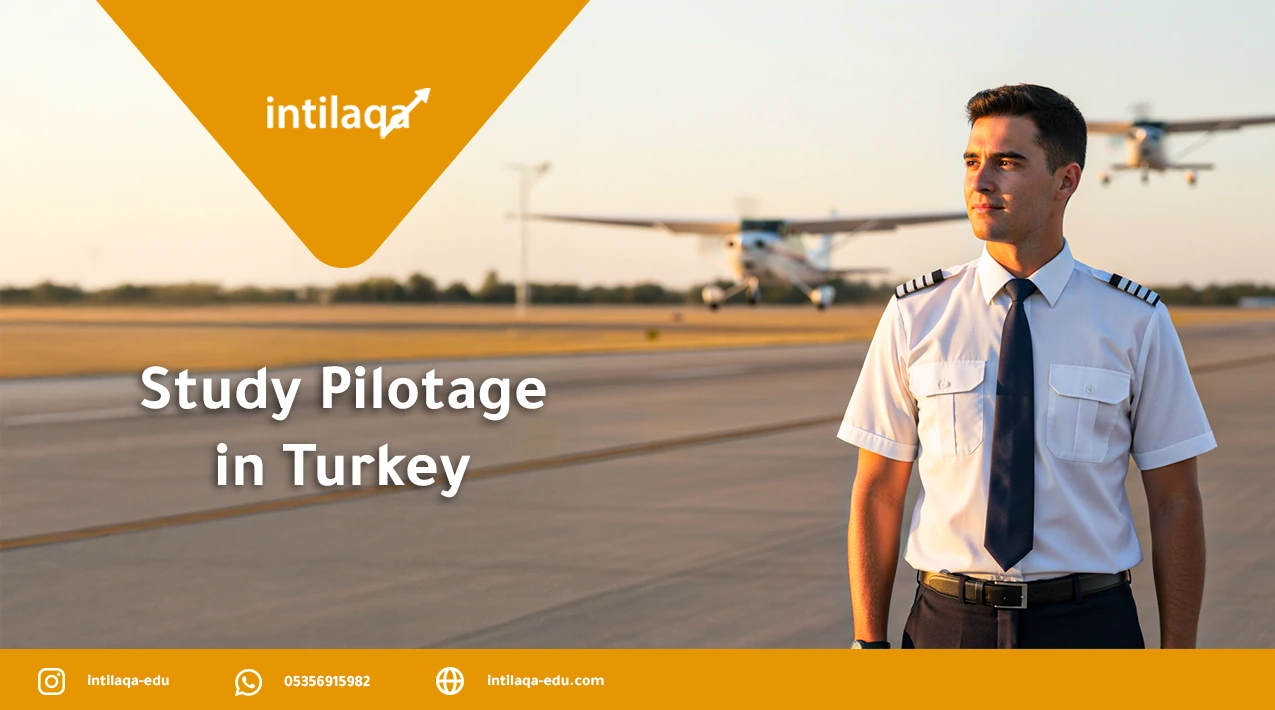
Do you dream of your office being the cockpit, with your daily view being the clouds? Study Pilotage in Turkey has become the top destination for international students seeking European quality and an appropriate cost. With one of the largest airports in the world and a rapidly growing aviation fleet, Turkish universities provide an ideal training environment combining academic education and practical experience.
In this comprehensive guide, we put everything you need to know in your hands; starting from the best accredited universities, through costs and medical conditions, up to the practical steps that guarantee you a promising future in the aviation sky.
What is the Pilotage Major?
The Pilotage major (known in Turkish universities as Pilotaj) is an intensive academic and practical program, directly aimed at preparing the student to become a commercial pilot qualified to fly aircraft in major airlines.
Studying Pilotage in Turkey differs from the Aviation Management major (which focuses on the administrative and logistical aspects of airports), and it is also distinct from merely joining quick aviation courses in institutes, as the student here gains two advantages simultaneously:
A Recognized University Bachelor’s Degree:
Granting the student a strong academic background in physics, mathematics, aerodynamics, and international aviation laws.
Accredited Flight License (ATPL Frozen):
Which is the highest license allowing its holder to work as an airline pilot, upon completing the required practical flight hours during the study years.
In Brief, this major is an integration of “theoretical science” and “practical skill”, where the student spends half of their time in lecture halls, and the other half in the Cockpit for training on real aircraft and simulators.
Advantages of Studying Pilotage in Turkey
The decision to Study Pilotage in Turkey enjoys a set of characteristics making it a preferred destination for international students aspiring to soar in the skies, and the most prominent of these advantages are:
Strong International Accreditations:
Turkish universities adhere to strict global aviation standards (ICAO) and the standards of the European Union Aviation Safety Agency (EASA), making the flight license issued from Turkey highly reliable and internationally recognized.
Training in English:
Since the official language of aviation in the world is English, Turkish universities offer this major entirely in English, ensuring the student is fully prepared to work in any global airline immediately upon graduation.
Advanced Infrastructure:
Turkish universities have invested heavily in purchasing modern fleets of training aircraft, in addition to providing technologically advanced flight Simulators, granting the student a realistic and precise experience.
Global Aviation Environment:
Turkey is considered a global logistical hub, and with the presence of Istanbul International Airport (one of the largest airports in the world), the student studies in a vibrant environment full of opportunities and close to the massive job market represented by Turkish Airlines and private airlines.
Cost vs. Quality:
Compared to European countries and the United States, Turkey offers an excellent equation combining high training quality with competitive tuition and living costs.
What are the Courses for the Pilotage Major in Turkey?
The approved curriculum when you Study Pilotage in Turkey is not limited solely to learning how to take off and land; it is a precise scientific program integrating physics, mathematics, and international navigation laws.
Study courses are usually divided into two main parts:
1. Basic Theoretical Courses (Ground School):
These courses form the cornerstone upon which the pilot builds their decisions in the air, including:
- Principles of Flight: Aerodynamics, how wings work, and the impact of physical forces on the aircraft.
- Navigation: Includes general navigation and radio navigation using advanced instruments to determine routes.
- Meteorology: Studying weather, clouds, wind, and how to read weather charts to avoid climatic hazards.
- Air Law: International and local regulations governing air traffic and the rights and duties of the pilot.
- Aircraft General Knowledge: Detailed study of the airframe, engines, electrical, and hydraulic systems of the aircraft.
- Human Performance: Understanding the limits of the human body, psychology, and the impact of pressure and altitude on the pilot.
2. Practical Training and Simulation:
In parallel with theoretical courses, the student begins applying what they learned through graduated practical courses:
- Simulator Training: To handle emergency situations and malfunctions in a safe environment.
- Instrument Rating: Learning to fly relying entirely on instruments without looking outside.
- Night Flight and Cross-Country Navigation: Flying long distances and between different airports.
How Many Years is the Study of Pilotage in Turkey?
Generally, the standard time duration for the Pilotage program in Turkey is 4 years of study (8 semesters), where the student is awarded a Bachelor’s degree upon graduation.
Since aviation study is mostly in English, the student undergoes an exemption test upon admission. In case they do not pass it, they must study a full year to learn the English language before beginning the four specialization years.
Best Universities to Study Pilotage in Turkey
Aviation study is available in an elite group of private Turkish universities providing training programs with global standards, most notably:
1. Ozyegin University:
Ozyegin University sits at the top of universities in this field thanks to its exclusive partnership with the prestigious “Ayjet” aviation academy. The university provides its students with outstanding academic education and very high employment opportunities after graduation given its strong reputation among airlines.
2. Okan University:
Okan University is distinguished by its strategic location near Sabiha International Airport in Istanbul, and possesses an advanced flight simulation center (Simulators). The university focuses on intensive practical training to graduate pilots ready for the job market directly.
3. Atilim University:
Located in the capital Ankara, Atilim University is unique in possessing a private aircraft hangar and a training runway at Esenboga Airport. It is considered an ideal choice for students seeking an educational environment combining calm, high focus, and significant technical support.
4. Istanbul Aydin University:
Aydin University is among the preferred universities for Arab and international students, providing the professional pilotage program supported by modern technological laboratories, in addition to its cooperation with accredited flight schools to implement the practical flight hours required for the license.
5. Antalya Bilim University:
Antalya Bilim University benefits from its location in the city of Antalya (the capital of Turkish tourism) which witnesses dense air traffic, providing a fertile environment for training. It offers a strong program in English and cooperates with professional aviation academies to ensure the quality of practical training.
6. Bahcesehir University (BAU):
Bahcesehir University adopts the slogan “a global university in the heart of Istanbul”, and offers the professional pilotage major with strict academic standards, focusing on developing leadership skills and technical English for the pilot, benefiting from its extensive international network.
Cost of Studying Pilotage in Turkey
Cost is considered one of the most important factors to consider when planning to Study Pilotage in Turkey. Expenses are divided into two main parts: annual university tuition and practical training fees.
First: Annual Tuition Fees
The following table clarifies the annual tuition fees for private universities, which cover the academic side and theoretical lectures:
| University | Average Annual Fees (US Dollars $) |
| Ozyegin University | $14,500 |
| Bahcesehir University | $9,000 |
| Atilim University | $11,000 |
| Okan University | $8,000 |
| Antalya Bilim University | $8,500 |
| Istanbul Aydin University | $8,000 |
Second: Flight Training Fees
The student must realize that the fees clarified in the table above do not include the costs of practical training in the sky.
- Required Amount: The average cost of practical training to obtain the license ranges between €50,000 to €58,000 for the entire study period.
- Reason for the Cost: This amount covers aviation fuel, aircraft rental, flight instructor wages, and fees for using airports and runways.
- Payment Method: This amount is not paid at once, but is usually paid in installments starting from the second or third year (upon beginning the actual practical training).
- Currency: These fees are mostly collected in the European currency (Euro €) due to the association of the aviation sector and aircraft maintenance with European standards and pricing.
Admission Requirements to Study Pilotage in Turkey
Admission requirements when you Study Pilotage in Turkey differ from other majors; while other majors rely only on the academic average, aviation relies on a strict triple equation: (Medical Fitness, Clean Legal Record, and Academic Qualification), to ensure the safety of lives in the air.
1. Academic Requirements (High School Diploma)
The basis for admission is the high school diploma, with flexibility in averages compared to public universities.
- High School Diploma: Students holding a passing grade (often 50% or 60% as a minimum in private universities) are accepted. Although the average is not a major obstacle, a strong background in mathematics and physics is considered an added advantage for the student.
- Academic Track: Graduates of the scientific track are preferred, but private universities accept graduates of other tracks provided they pass internal admission exams if any.
- Academic Documents: The university requires the original high school diploma and transcripts (translated and notarized), in addition to the degree equivalency (Denklik) from the Turkish Ministry of Education.
2. Medical Requirements (Class 1 Medical Examination)
This is the “decisive” condition that cannot be compromised whatsoever, and supersedes any high academic conditions in importance.
- Class 1 Medical Certificate: The student must exclusively obtain a first-class medical report, issued by a hospital accredited by the Turkish Directorate General of Civil Aviation (SHGM).
- Examination Content: The examination includes vision (and color distinction), hearing, heart health, nervous system, and comprehensive blood analyses. Any defect in these functions may prevent the student from admission even if their academic average is 100%.
3. Legal and Language Requirements
Since the pilot bears a security and international responsibility, the language and criminal record conditions are considered very strict.
- Criminal Record: A “criminal record” document (Adli Sicil Kaydı) is required proving the student is free from any criminal precedents or crimes preventing them from obtaining a flight license according to civil aviation laws.
- Proof of Language Proficiency: The study is 100% in English, and the global language of aviation is English. Therefore, the student is obligated to submit a (TOEFL) certificate or pass the university’s special language exam. Failure in the exam means studying a mandatory language preparatory year before starting aviation.
Future of Aviation Graduates and Average Salaries: Is It Worth the Investment?
The amount paid to study pilotage may seem large at first glance, but when looking at the financial return and career opportunities, it becomes clear that it is one of the best educational investments in terms of Return on Investment (ROI).
Here is a realistic look at what awaits the graduate:
1. Increasing Global Demand (Pilot Shortage)
Reports from major aircraft manufacturing companies (like Boeing and Airbus) indicate that the world faces a severe “pilot shortage crisis” over the next decade, especially with airlines expanding and the travel sector recovering. This means that a graduate of the “Pilotaj” major from Turkey has almost guaranteed employment opportunities, not only in Turkish Airlines or Pegasus, but also in Gulf and European airlines thanks to the international accreditations of the degree.
2. Fast Career Path
Unlike other majors requiring long years for promotion, the pilot begins their career path with the rank of “First Officer” immediately upon graduation and completing the required flight hours (Type Rating). After a few years of experience (mostly from 3 to 5 years), they get promoted to become a “Captain”, which is the leap that doubles the salary.
3. Average Salaries
Pilots are considered among the highest-earning employees globally. Although salaries vary by airline and aircraft type, the approximate average is as follows:
- Junior First Officer: The salary typically ranges between $3,000 to $5,000 monthly at the start of employment.
- Captain: After gaining experience, the salary jumps to reach between $10,000 to $15,000 monthly, and may exceed $20,000 in major and Gulf airlines.
Conclusion: The cost of studying aviation is “paid once,” but its financial returns continue for life, as the pilot can recover the entire costs of their study during the first two or three years of their work.
How Do I Study Pilotage in Turkey?
To start your journey towards the cockpit in Turkey, and take your first steps to become a “Captain,” follow these methodical steps ensuring you a seat in the best aviation colleges, with the help of your academic expert:
1. Choosing the Right University:
Given the high costs and varying training quality among universities, the choice should not be random. The Intilaqa team will help you in this step to choose the most appropriate university for your budget and goals.
2. Preparing the File and Required Documents:
Start preparing your file carefully, as the documents include the high school diploma, transcripts, and passport. The most important thing in this specific major is to start the procedures for the “Class 1 Medical Certificate” to ensure your medical eligibility before proceeding further.
3. Official Application to the University:
To avoid any mistakes or delays in booking the seat (since aviation seats are very limited), the Intilaqa team will assist you in this phase to guarantee the issuance of the preliminary approval as fast as possible.
4. Securing the Seat and Obtaining Final Acceptance:
Once the “Initial Acceptance Letter” is issued, you can confirm your seat reservation in the aviation college by paying the first installment of the university tuition fees. After payment, you receive the “Final Acceptance Letter,” which is the official document proving your university enrollment.
5. Obtaining a Student Visa:
Use the final acceptance letter as an essential document to apply for a “Student Visa” from the Turkish embassy or consulate in your country of residence, which is a mandatory step to travel legally.
6. Travel and Final Registration at the University:
After your arrival in Turkey, the final registration process and handing over original documents begin, immediately followed by starting your theoretical and practical study.
How Does the Intilaqa Team Help You?
The Intilaqa Educational Team works to assist you step-by-step to choose the most appropriate major and university for you in Turkey, according to your academic interests and study budget.
We offer you a comprehensive free consultation that includes:
- Recommending the best Turkish universities that teach your major.
- Clarifying available costs and scholarships.
- Full follow-up in the registration process until final acceptance.
Whether you plan to study Pilotage in Turkey or any other major, you can start by learning about the details of Studying in Turkey via our complete guide:
Study in Turkey