Mechanical engineering is the driving force behind modern industries, from automotive technology and aerospace engineering, to complex robotic systems. With the rapid industrial rise the country is experiencing, study Mechanical Engineering in Turkey has become a strategic destination for students seeking an education that combines scientific theory with hands-on application.
In this guide, we give you a complete summary of everything you need to know to start your academic path — from the nature of the coursework and costs, to admission requirements and the best universities offering advanced engineering labs that prepare you for the global job market.
What Is Mechanical Engineering?
Mechanical Engineering is one of the broadest and most comprehensive engineering fields, combining principles of physics, mathematics, and materials science to design and analyze motion and thermal systems.
Since this major is concerned with studying machines and how they work, it naturally overlaps with other engineering fields; it forms the foundation that Automotive Engineering, Aerospace Engineering, and even robotics systems rely on. A mechanical engineer’s role isn’t limited to design alone — it covers vital areas including:
Energy Systems and Thermodynamics:
It doesn’t stop at power plants — it also includes designing advanced HVAC systems to ensure energy-efficient consumption inside buildings and factories, in addition to developing renewable energy solutions.
Manufacturing and Production:
The engineer is responsible for turning raw materials into final products, by designing machines and automated production lines, and directly overseeing manufacturing processes to ensure quality and reduce resource waste.
Maintenance and Engineering Analysis:
Using simulation tools to examine material stress and machine vibration, helping predict failures before they occur, and ensuring equipment operates with maximum safety for as long as possible.
As such, Mechanical Engineering in Turkey is a strategic choice for students who want versatile skills that let them work across various industrial sectors.
Advantages of Studying Mechanical Engineering in Turkey
Studying engineering in Turkey draws its strength from the fact that the country itself is a rising industrial power, which directly reflects on the quality of education. When you choose Mechanical Engineering in Turkey, you’ll gain several academic and professional advantages, including:
Advanced Technical Infrastructure:
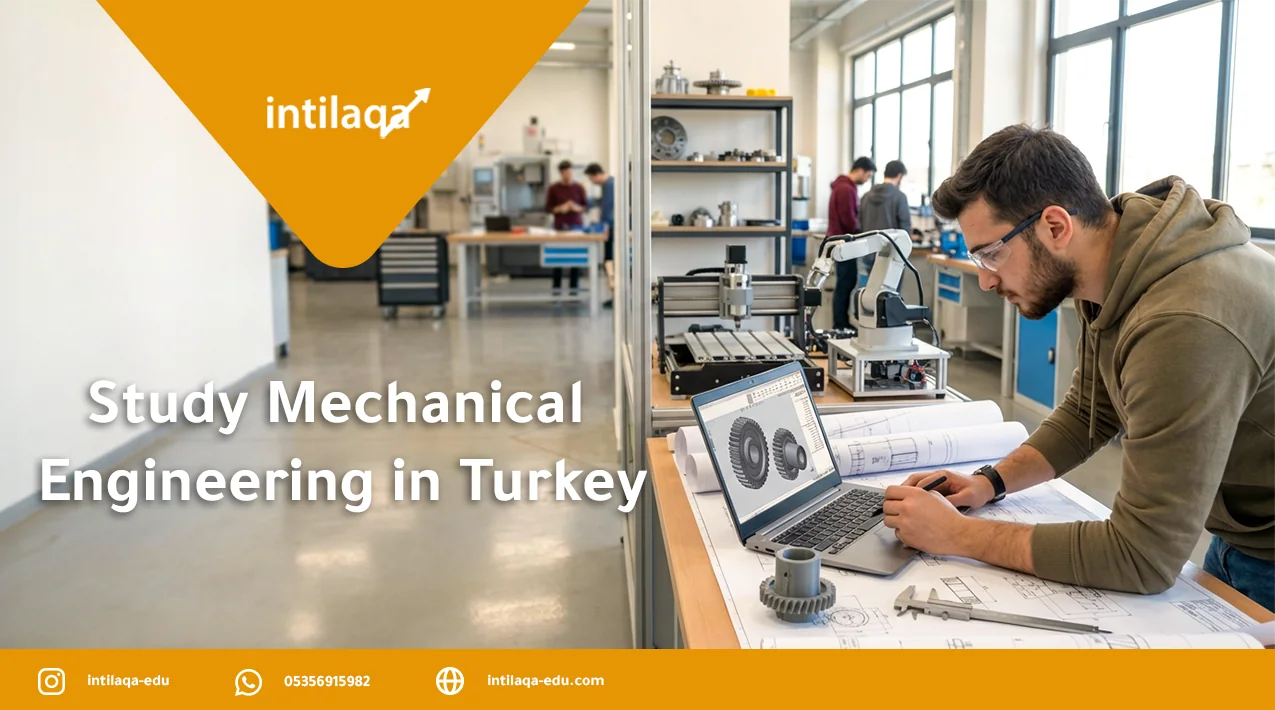
Turkish universities place great emphasis on the applied side, providing modern labs and workshops that let students work with CNC machines, robotics systems, and engineering simulation software during their studies.
International Accreditations (ABET):
Many Turkish universities hold accreditation from the American “ABET,” a global standard that ensures curricula align with the latest international requirements, making it easier for graduates to work or pursue further studies abroad.
Connection to the Industrial Job Market:
Given Turkey’s advancement in the automotive and defense industries, universities provide internship opportunities at major factories, narrowing the gap between theory and practice.
Student Exchange Programs (Erasmus):
As Turkey is a member of the European Higher Education Area, outstanding students have a special opportunity to study at a European university for a semester or an academic year. These programs reward hard-working students by boosting their academic path and expanding their international network.
Studying in English:
A wide range of universities offer Mechanical Engineering programs in English, removing the language barrier and preparing students to work directly at global companies.
Mechanical Engineering Curriculum in Turkey
The curriculum for Mechanical Engineering in Turkey carefully blends a strong engineering foundation with direct hands-on application, to ensure the graduation of capable engineers. Courses are divided as follows:
1. The Engineering Foundation Years (First and Second Year)
At this stage, the student’s “engineering mindset” is built, and they’re equipped with the scientific tools needed to understand machines and motion:
Basic Sciences:
- General Physics (1 & 2).
- General Chemistry.
- Calculus 1 & 2.
- Linear Algebra and Differential Equations.
Common Engineering Courses:
- Computer-Aided Engineering Drawing (AutoCAD / SolidWorks).
- Introduction to Mechanical Engineering (a comprehensive overview course).
- Programming for Engineers (usually Python or MATLAB).
- Statics.
- Strength of Materials.
- Material Science.
- Dynamics.
2. Specialization and Advanced Years (Third and Fourth Year)
Here, the student moves into the core of Mechanical Engineering in Turkey, as courses shift toward precise, specialized technical subjects:
Core Mechanics Courses:
- Thermodynamics — one of the most important courses in the major.
- Fluid Mechanics.
- Heat Transfer.
- Machine Elements.
- Theory of Machines.
Manufacturing and Control Courses:
- Manufacturing Processes.
- Measurements.
- Automatic Control.
- Mechanical Vibrations.
- Graduation Project — a hands-on application of designing a complete mechanical system.
Important Note: Course names may vary slightly between universities, but the scientific content remains consistent and aligned with the standards of Turkey’s Council of Higher Education (YOK).
Duration of Mechanical Engineering Studies in Turkey
The official duration for studying Mechanical Engineering in Turkey at the bachelor’s level is 4 years (8 semesters).
One preparatory year is added to learn the language (English or Turkish) if the student doesn’t hold a language proficiency certificate or doesn’t pass the language exemption exam, bringing the total duration to 5 years.
Master’s Studies in Mechanical Engineering in Turkey
Earning a master’s degree in this field is no longer just an “extra certificate” — it’s the only path to move from routine engineering tasks into advanced design roles and technical leadership. When you choose to continue studying Mechanical Engineering in Turkey at the graduate level, you’ll find two academic tracks ahead of you, each serving entirely different career goals:
1. Thesis-Based Master’s (Tezli) – The Academic and Research Track
This program is the first choice for students who have a passion for scientific discovery or are planning an academic career (PhD) in the future. The essence here isn’t just passing exams — it’s preparing a rigorous “research thesis” that addresses a specific engineering problem. Key courses in this track:
- Advanced Engineering Mathematics: to gain the tools for solving complex equations.
- Finite Element Method (FEM): to digitally simulate stresses in structures.
- Computational Fluid Dynamics (CFD): to analyze fluid and gas flow with high precision.
- Scientific Research Methods and Ethics: to learn how to write and publish research papers.
2. Non-Thesis Master’s (Tezsiz) – The Professional and Applied Track
This option is designed for engineers already in the job market who want to advance their careers and gain new managerial and technical skills without needing to dedicate themselves to lengthy academic research. Instead of a thesis, the student completes an “applied graduation project.” Key courses in this track:
- Engineering Project Management: learning financial and time planning for industrial projects.
- Advanced Manufacturing Technologies: studying the latest production methods, such as 3D printing and smart manufacturing.
- Mechanical Systems Design: focusing on the applied side of building machines.
- Professional Graduation Project: studying a real-world case from the market and finding solutions for it.
PhD Studies in Mechanical Engineering in Turkey
The PhD stage is a “passport” from traditional engineering work into the world of innovation and academic elite. When you decide to pursue a PhD in Mechanical Engineering in Turkey, you’re not just enrolling in an ordinary study program — you’re joining a research environment aimed at producing scientists capable of solving the most complex industrial problems and leading R&D teams at major companies.
The journey typically takes 4 years, and it’s designed according to a strict methodology divided into two main stages:
1. The Knowledge Deepening and Qualifying Stage
In the early years, the student doesn’t settle for surface-level knowledge — they undergo an intensive program of advanced courses that reshape their understanding of physical phenomena. This stage ends with the “comprehensive qualifying exam” (Yeterlilik Sinavi), the decisive test that determines whether the student has the scientific tools needed to become an independent researcher. Key courses and areas at this stage:
- Continuum Mechanics: diving into the precise behavior of materials and fluids at the microscopic level.
- Advanced Applied Mathematics: using complex mathematical models to solve nonlinear physical problems.
- Engineering Optimization Methods: learning algorithms that help achieve the optimal design at the lowest cost and weight.
- Fracture Mechanics: a precise scientific study of the causes of material failure and how to prevent engineering disasters.
2. The Dissertation and Scientific Output Stage
After proving their merit, the researcher moves into the heart of the PhD, where they must present a “new contribution to science” that no one has made before. This stage requires conducting precise lab experiments or advanced digital simulations, and publishing research papers in peer-reviewed international journals (SCI). Research in Turkey often focuses on future technologies such as:
- Composite and Smart Materials: developing lightweight, rigid structures to serve the defense and aerospace sectors.
- Micro-Electro-Mechanical Systems (MEMS): designing nano-scale mechanical devices for medical applications.
- Additive Manufacturing: developing 3D printing technologies for industrial metals.
- Advanced Robotics: improving the dynamics and efficiency of industrial robots.
Best Universities for Studying Mechanical Engineering in Turkey
When choosing your destination for studying Mechanical Engineering in Turkey, it’s essential to look for universities with a genuinely “industrial” environment and labs that simulate real-world conditions. Here are the top universities and what sets each apart in this field:
1. Istanbul Aydin University
Istanbul Aydin University is known as an applied university with massive “technology centers” on campus, offering fully equipped hydraulics labs along with strong internship opportunities thanks to its extensive industrial partnerships.
2. Atilim University
Atilim University stands out for its research strength and its globally recognized center of excellence in “metal forming,” making it the strongest choice for those wanting to specialize in the defense and aerospace industries.
3. Halic University
Halic University offers education that intelligently balances theory and practice, with a strong focus on mastering modern design software (CAD/CAM) to prepare students directly for the job market.
4. Beykent University
Beykent University offers solid engineering education focused on strong fundamentals, with good thermodynamics labs aimed at producing highly competent practicing engineers.
5. Nisantasi University
Nisantasi University stands out for its smart campus, “NeoTech Campus,” and focuses its mechanics teaching on the digital side and simulation technologies to keep pace with the Fourth Industrial Revolution.
6. Ozyegin University
Ozyegin University is one of the elite universities offering state-of-the-art labs. It stands out for very high employment rates among its graduates, and its curricula focus on entrepreneurship and sustainable engineering.
Cost of Studying Mechanical Engineering in Turkey
Tuition fees for Mechanical Engineering in Turkey are affected by several factors, most importantly the university’s ranking and the language of instruction. Since this is an applied major requiring heavy dynamic labs, precise measuring instruments, and costly engineering simulation software, tuition fees are set to cover the cost of this high-end technical equipment.
Bachelor’s Stage (Annually)
As an industrial major requiring intensive training in workshops and labs, annual fees for the bachelor’s stage at private universities typically range between about $3,000 and $11,000. Programs taught in English at universities with international partnerships tend to be at the higher end of this range.
Master’s Stage (Full Program)
For graduate programs, whether you choose the research track (thesis) or the professional track (non-thesis), the total program cost ranges between $4,000 and $12,000, and the price varies depending on the research facilities the university provides to its students.
PhD Stage (Full Program)
As for the PhD stage, which requires conducting complex experiments and publishing advanced research in manufacturing and energy fields, average fees for the full program range between $6,000 and $15,000, and the figure may be higher at elite universities with world-class R&D centers.
Admission Requirements for Mechanical Engineering in Turkey
Private Turkish universities are known for a flexible, encouraging admission system, placing no bureaucratic obstacles in front of international students, and instead focusing on academic qualifications and a desire for technical growth. Here are the precise details of admission requirements and necessary documents for each academic stage:
1. Bachelor’s Stage Requirements
Admission requirements for engineering faculties are clear and specific, summarized in the following points:
- Academic Background: Since mechanics fundamentally relies on mathematics and physics, the high school diploma must be from the science track (or an accepted industrial/technical certificate), to ensure the student has the necessary scientific fundamentals.
- Required GPA: Competition at private universities is quite manageable; a good passing grade in high school (starting from 60% and above) is usually enough to secure preliminary admission.
- Language Requirement: Studies cannot begin without language proficiency. A language proficiency certificate must be submitted, or the student must pass the university’s “exemption exam.” Otherwise, the student enters a mandatory preparatory year.
- Required Documents: Passport copy, transcript, high school diploma (translated and certified), and personal photos.
2. Master’s Stage Requirements
To move into graduate studies and specialized focus, the following criteria must be met:
- Previous Major: Absolute priority is given to holders of a bachelor’s degree in directly related majors (such as Mechanical Engineering, Mechatronics, Automotive Engineering, or Energy).
- Cumulative GPA: The bachelor’s graduation GPA must be acceptable, with a minimum of 2.00 out of 4.00 (or its equivalent) for the file to be accepted.
- Language Proof: A document proving proficiency in the language of instruction (English or Turkish) must be submitted as a basic requirement for registration and starting lectures, or the student enters a language preparatory year.
- Required Documents: Passport copy, bachelor’s degree certificate and transcript (translated and certified), language certificate, and personal photos.
3. PhD Stage Requirements
The criteria at this stage are selective, as it is an advanced research degree:
- Type of Master’s Degree: This is the most important requirement; universities only accept students holding a thesis-based (“Tezli”) master’s degree, as it proves their prior research experience.
- Academic Excellence: A high cumulative GPA in the master’s degree is required (usually no less than 2.50 or 3.00) as evidence of academic competence.
- Language Requirement: Proficiency in a foreign language (such as English) is usually required through accredited tests (such as TOEFL or YDS), even in Turkish-taught programs, to enable the researcher to access international sources and references.
- Research Proposal: Submitting an initial draft explaining the engineering problem the student intends to solve, which is the criterion the academic advisor uses to approve the student.
- Required Documents: Passport copy, master’s degree certificate and transcript (translated and certified), a copy of the previous master’s thesis, language certificate, research proposal, and personal photos.
Career Future for Mechanical Engineering Graduates in Turkey
Mechanical engineering is no longer limited to traditional factories — it has become the core driver of future technologies, making graduates of this major a “rare commodity” in demand across all sectors. When you graduate from Mechanical Engineering in Turkey, the job market will be waiting for you in growing fields that ensure job security:
1. The Automotive and Electric Vehicle Sector
With the global shift toward electric vehicles (EVs) and self-driving technology, companies are racing to find engineers capable of designing new drivetrain systems and developing lightweight structures — currently the fastest-growing field.
2. Defense and Aerospace Industries
Turkey and the wider region are witnessing a boom in the drone and defense systems industry. The mechanical engineer is the key element here, designing aerodynamic structures and jet propulsion systems.
3. Energy and Advanced HVAC Systems
No smart building or factory can operate without highly efficient HVAC systems. Companies are constantly looking for experts to reduce energy consumption in massive facilities.
4. Automation and Robotics
Modern factories no longer rely on human labor, but on fully automated production lines. Your role here is designing and maintaining the robotic arms that carry out precision manufacturing.
How Do I Study Mechanical Engineering in Turkey?
To ensure a successful, hassle-free start to your studies, we’ve mapped out a clear, specific path that guarantees you a seat at distinguished engineering faculties. Follow these steps:
1. Choosing a University With High-End Technical Facilities
Since mechanical engineering relies entirely on machines and workshops, the top priority is choosing a university with real dynamic labs and manufacturing centers — not just theoretical classrooms. Avoid the confusion of choosing on your own, and reach out to us so we can give you a list of universities with international accreditations and factory partnerships, ensuring a hands-on education that keeps pace with technology.
2. Preparing the File and Official Documents
Start preparing your documents early to speed up the registration process and avoid delays. You’ll mainly need your high school diploma (from the science track) properly translated and certified, your transcript, plus a copy of a valid passport and recent personal photos.
3. Consulting the Experts (Intilaqa)
Instead of wasting time searching, let the Intilaqa experts take the wheel. We’ll review your academic file and suggest the university best suited to your grades and budget, then handle the entire application process on your behalf for free and with complete professionalism, while securing the best discounts and partial scholarships available exclusively to you.
4. Confirming Preliminary Enrollment
After submitting your application, you’ll receive a “preliminary acceptance letter.” Since seats in engineering majors are limited, you’ll need to transfer the first tuition installment to the university’s official account to secure and confirm your seat, after which you’ll immediately receive the “final acceptance document.”
5. Obtaining the Student Visa
Once you have your final acceptance, head directly to the Turkish embassy or consulate in your country to apply for a “student visa.” This step is necessary and legally required to enter Turkish territory and reside there for study purposes.
6. Arrival and Starting Your Academic Journey
Welcome to Turkey! Upon your arrival, we’ll be right there with you to guide you through completing administrative registration at the university’s student affairs office and receiving your student card, after which you’ll immediately begin your exciting academic journey.
How Can the Intilaqa Team Help You?
The Intilaqa Education team works to help you step by step choose the right major and university for you in Turkey, according to your academic interests and study budget.
We offer you a comprehensive free consultation that includes:
- Recommending the best Turkish universities that teach your major.
- Clarifying the costs and scholarships available.
- Full follow-up throughout the enrollment process until final acceptance.
Whether you’re planning to study Mechanical Engineering in Turkey or any other major, you can start learning about the details of studying in Turkey through our complete guide:
Studying in Turkey