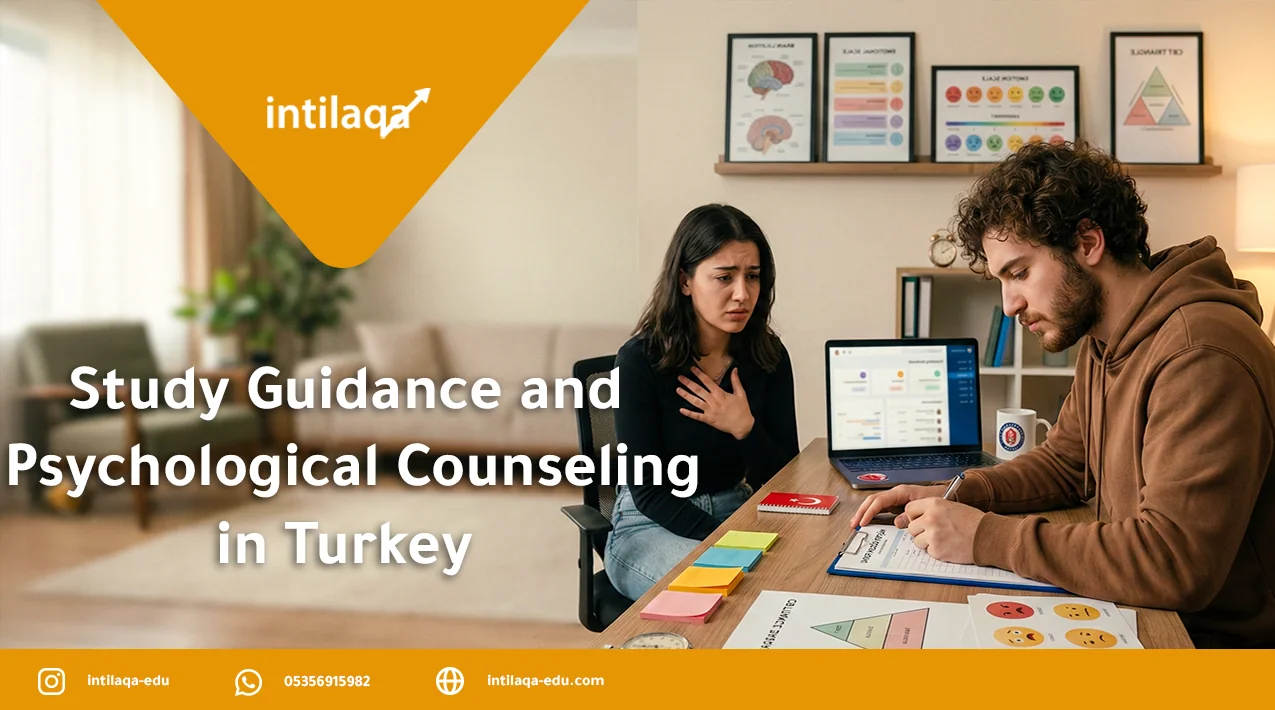
Do you have a passion for listening and a genuine desire to help others? In a world facing increasing personal and social pressures, psychological support has become an important part of modern communities. For this reason, choosing to Study Guidance and Psychological Counseling in Turkey offers students an academic path that combines modern educational approaches with extensive practical training.
In this guide, we cover the main aspects of the program, including universities, tuition fees, admission requirements, and career opportunities in schools, healthcare institutions, and companies.
What Is Guidance and Psychological Counseling?
Guidance and Psychological Counseling is an important branch of educational and psychological sciences that focuses on providing professional support to individuals, helping them understand themselves, address personal or social challenges, and achieve greater psychological adjustment.
When students Study Guidance and Psychological Counseling in Turkey, they develop the scientific knowledge and practical skills needed to work as psychological counselors who support individuals facing everyday life challenges, rather than focusing primarily on severe mental illnesses, which fall within the field of psychiatry.
The field focuses on several core areas designed to support individual and social development:
Self-Discovery:
Counselors do more than listen. They help individuals gain deeper insight into themselves, understand their motivations and personal interests, develop a more positive self-image, strengthen self-confidence, and recognize their individual abilities and areas of creativity.
Decision-Making:
The field helps individuals develop effective thinking and decision-making skills to reduce uncertainty when facing important choices, particularly when selecting a university major or career path that matches their personal abilities and goals.
Psychological and Social Adjustment:
Counselors provide support that helps individuals adapt to their social environments, address feelings of isolation or anxiety, and develop healthy and balanced relationships with others in educational settings and workplaces.
Prevention and Personal Development:
The field also emphasizes preventive and developmental support by teaching important life skills such as anger management, conflict resolution, and stress management. These skills can help prevent relatively minor difficulties from developing into more complex psychological problems.
Why Study Guidance and Psychological Counseling in Turkey?
The decision to Study Guidance and Psychological Counseling in Turkey attracts many international students because Turkish universities combine theoretical foundations with modern practical applications.
Some of the main advantages of studying this field in Turkey include:
Educational Quality and International Academic Standards:
Turkish universities follow the European Bologna Process, supporting curricula that reflect contemporary approaches in educational psychology and psychological counseling.
Practical and Field Training:
Programs are not limited to theoretical education. Students may also receive field training in schools, rehabilitation centers, and social institutions, allowing them to gain practical experience working with real cases before graduation.
Different Languages of Instruction:
Several universities offer programs entirely in English or through mixed programs combining English and Turkish, helping international students access the field through different language options.
Qualified Academic Staff:
Programs are taught by academics with diverse educational and research backgrounds, including faculty members who have earned degrees from international universities.
A Rich Cultural and Social Environment:
Turkey’s cultural diversity provides counseling students with exposure to different social and cultural backgrounds, helping them better understand individual and cultural differences, which are important aspects of effective psychological counseling.
Affordable Study Costs:
Compared with many European countries and the United States, the tuition fees for students who Study Guidance and Psychological Counseling in Turkey, together with general living costs, can be relatively accessible for a broad range of international students.
Guidance and Psychological Counseling Courses in Turkey
Turkish universities generally follow a progressive curriculum in preparing psychological counselors. The early years focus on foundational subjects, while later years introduce specialized courses and practical applications.
The following are some of the main subjects typically studied during each academic year:
First Year: Foundations and Academic Knowledge
The first year introduces students to the fundamental concepts of the humanities, education, and biological sciences that support later specialization:
- Introduction to Psychology: Understanding the fundamental principles of human behavior.
- Sociology of Education: Studying the relationship between schools and society.
- Philosophy of Education: Exploring the intellectual approaches that influence educational processes.
- Physiological Psychology: Studying the biological and neurological foundations of human behavior.
Second Year: Development and Learning
During the second year, students develop a deeper understanding of human development and how learning takes place, making this an important stage for those who Study Guidance and Psychological Counseling in Turkey:
- Developmental Psychology: Detailed study of childhood, adolescence, and adulthood.
- Psychology of Learning: Learning theories and how people acquire information and skills.
- Social Psychology: Studying individual behavior within groups and the influence of others.
- Statistics in Education: Statistical principles needed to understand research and psychological measurement.
Third Year: Counseling Theories and Techniques
The third year represents the core of the major, as students begin studying professional counseling tools and different therapeutic and counseling theories:
- Psychological Counseling Theories: Studying different therapeutic approaches, including psychoanalytic, behavioral, and cognitive schools.
- Principles and Techniques of Counseling: Practical training in counseling interview skills.
- Vocational Counseling: Tools for helping individuals plan their professional futures.
- Psychological Assessment: Training in applying and interpreting psychological tests and assessment tools.
- Group Counseling: Theories and approaches used when working with counseling groups.
Fourth Year: Practical Application and Field Practice
The final year focuses on transforming theoretical knowledge into practical experience and preparing students for professional work:
- Field Practice: Intensive practical training in schools or counseling centers under direct supervision.
- Psychopathology / Behavioral Disorders: Learning to recognize symptoms of psychological disorders for assessment and referral when necessary.
- Professional Ethics: Ethical and legal principles governing the work of psychological counselors.
- Family and Marriage Counseling: An introduction to dealing with family-related challenges, often offered as an elective course.
- Graduation Project: Completing an academic research project or an applied project in the field of counseling.
How Long Does It Take to Study Guidance and Psychological Counseling in Turkey?
The standard bachelor’s degree duration for students who Study Guidance and Psychological Counseling in Turkey is 4 years, divided into 8 academic semesters.
The duration may increase by one additional year (Preparatory Year) if the student needs to learn the language of instruction, whether Turkish or English, bringing the total duration to 5 years.
Master’s in Guidance and Psychological Counseling in Turkey
Graduate studies allow psychological counselors to move from general professional practice toward more specialized academic and applied knowledge. Students pursuing a master’s degree in Guidance and Psychological Counseling in Turkey generally encounter two main academic tracks:
1. Thesis-Based Master’s Degree (Tezli Yuksek Lisans):
This track is designed for students interested in theoretical research, academic careers, or continuing to PhD studies. The program lasts two academic years and focuses on developing a deeper understanding of counseling theories and conducting behavioral research. Courses may include:
- Advanced research methodologies in educational and psychological sciences.
- Advanced and comparative theories of counseling and psychotherapy.
- Psychological measurement techniques and the development of tests and assessment scales.
- Completion of an original research thesis examining a behavioral phenomenon or evaluating the effectiveness of a specific counseling program.
2. Non-Thesis Master’s Degree (Tezsiz Yuksek Lisans):
This track is designed for practicing counselors who want to strengthen their applied professional skills rather than pursue a research-focused path. It lasts three semesters and focuses directly on educational and counseling applications and practical problem-solving. Major areas may include:
- School counseling strategies and approaches to student crises.
- Career counseling and techniques for future planning.
- Applications of cognitive behavioral and group approaches in educational environments.
- Graduation Project: An applied project focusing on a real case or the design of a counseling program for an institution.
Key Master’s Research Areas and Specializations:
Graduate programs may allow students to specialize in areas that address contemporary social challenges, including:
- Family and Marriage Counseling: Understanding family dynamics and approaches to marital conflict and parenting challenges.
- Mental Health Counseling: Addressing common psychological difficulties such as anxiety and depression and studying preventive programs.
- Career and Vocational Counseling: Helping individuals make career decisions and adapt to changing work environments.
- Counseling for Individuals with Special Needs: Developing psychological support and rehabilitation programs for individuals with special needs and their families.
PhD in Guidance and Psychological Counseling in Turkey
A PhD represents the highest academic stage in Guidance and Psychological Counseling in Turkey and is intended to prepare academics capable of university-level leadership and managing specialized centers. The program combines advanced theoretical study with applied counseling practice and generally takes 4 years through three main stages:
1. Advanced Academic Foundation: Coursework
The first year focuses on building the researcher’s advanced theoretical foundation through intensive courses designed not simply to teach counseling concepts, but to critically analyze counseling theory. Major areas include:
- Advanced Counseling Theories.
- Advanced Research Methods & Statistics, including qualitative and quantitative approaches.
- Psychological supervision and its practical applications in clinical and school environments.
2. Research Proficiency Examination:
After successfully completing the required coursework, PhD students take the Proficiency Exam (Yeterlilik) before an academic committee. The examination includes written and oral components and is intended to evaluate the researcher’s intellectual maturity, understanding of psychological assessment and diagnostic tools, and ability to develop independent research ideas at the doctoral level.
3. Thesis and Research Stage:
Students then move from coursework to several years of independent academic research. The doctoral dissertation is expected to contribute to the academic literature through new counseling models or research into complex psychological phenomena within particular cultural contexts. Research in Turkey may focus on areas such as:
- Family & Marriage Counseling in the context of social change.
- Trauma & Crisis Management.
- Psychological adjustment, migration, and Multicultural Counseling.
- Psychological Assessment Adaptation and the adaptation of international psychological tests and scales.
Best Universities to Study Guidance and Psychological Counseling in Turkey
Students looking for strong academic preparation and practical training can find several private universities offering programs related to Guidance and Psychological Counseling in Turkey. Some of the notable options include:
1. Bahcesehir University (BAU):
Bahcesehir University is known for its international academic environment and its integration of technology into education. Its approach gives students exposure to modern developments in school mental health and counseling.
2. Istanbul Sabahattin Zaim University:
Istanbul Sabahattin Zaim University has a strong academic focus on educational and psychological sciences. Its programs combine contemporary theories with cultural perspectives and provide students with an academically focused environment for studying Guidance and Psychological Counseling.
3. Istanbul Aydin University:
Istanbul Aydin University places considerable emphasis on applied education and offers training opportunities and partnerships with rehabilitation centers, helping students develop practical experience before graduation.
4. Biruni University:
As Biruni University has a strong orientation toward health-related education, students can benefit from an academic environment that supports a deeper understanding of the biological dimensions of human behavior.
5. Istanbul Kultur University:
Istanbul Kultur University offers an established academic environment with attention to individual and family mental health, balancing classical psychological theories with contemporary applications.
6. Istanbul Topkapi University:
Istanbul Topkapi University provides an option for students seeking an accessible educational environment, with an emphasis on developing professional, personal, and communication skills relevant to counseling work.
Cost to Study Guidance and Psychological Counseling in Turkey
The cost to Study Guidance and Psychological Counseling in Turkey varies according to the university, academic level, language of instruction, and available practical training facilities. Private universities offer different tuition ranges for bachelor’s, master’s, and doctoral programs:
Bachelor’s Degree: Annual Tuition Fees
Annual tuition fees range between 3,000$ and 6,000$. Differences in tuition depend mainly on factors such as the language of instruction, with English-taught programs generally costing more, the university’s academic positioning, and the availability of practical training centers on campus.
Master’s Degree: Total Program Cost
The total cost of a master’s program ranges between 3,000$ and 9,000$ for either thesis-based or non-thesis tracks. These fees generally cover coursework, academic supervision, and training related to modern psychological assessment tools.
PhD Degree: Total Program Cost
For students pursuing the highest academic level, the average total cost of a 4-year doctoral program ranges between 4,500$ and 8,000$. The program provides a research environment and academic partnerships that can support students pursuing international academic publication.
Requirements to Study Guidance and Psychological Counseling in Turkey
Faculties of Education and Social Sciences at private Turkish universities generally adopt flexible admission approaches for international students. Requirements differ according to the academic level:
1. Bachelor’s Degree Requirements
- High School Diploma: Unlike strictly medical programs, Guidance and Psychological Counseling generally accepts students from different secondary-school backgrounds, including science and literature tracks, as the field combines educational, psychological, and social sciences.
- Required Grade: A high school average of approximately 50% to 60% is generally sufficient for admission to most private universities.
- Language Requirement: Students who hold a recognized certificate demonstrating the required level of proficiency can begin their degree directly. Otherwise, they may take the university’s language exemption examination. Students who do not pass enroll in a preparatory language year.
- Required Documents: A copy of a valid passport, the original high school diploma and academic transcript translated and officially certified, and a recent personal photograph.
2. Master’s Degree Requirements
- Academic Background: Applicants are preferably expected to hold a bachelor’s degree in Guidance and Psychological Counseling, Psychology, Sociology, or Educational Sciences, providing the foundational knowledge needed for advanced study of behavioral and counseling theories.
- Bachelor’s GPA: Private universities generally provide flexibility regarding previous university grades, and applicants are commonly considered if their cumulative GPA is at least 2.00 out of 4.00.
- Language Requirement: International language certificates are not always required before application. Students may instead take the university’s own language proficiency examination and begin the program directly if they pass.
- Required Documents: A passport copy, bachelor’s degree certificate and transcript translated and officially certified, and a personal photograph.
3. PhD Requirements
- Type of Master’s Degree: Applicants must hold a thesis-based master’s degree (Tezli). Professional non-thesis master’s programs do not qualify graduates to continue to doctoral studies at Turkish universities.
- GPA Requirement: Due to the research-intensive nature of doctoral study, universities commonly require a strong master’s GPA of approximately 3.00 out of 4.00.
- Foreign Language Requirement: This is a central requirement under the Turkish Council of Higher Education (YÖK). Applicants are required to achieve a minimum score of 55 on the YDS foreign-language examination or provide an accepted equivalent result from an internationally recognized test such as TOEFL.
- Required Documents: A comprehensive academic application file containing a passport copy, bachelor’s and master’s certificates and transcripts translated and officially certified, proof of meeting the foreign-language requirement, a preliminary PhD research proposal, and academic recommendation letters.
Career Prospects for Guidance and Psychological Counseling Graduates
Guidance and Psychological Counseling has expanded significantly in recent years and is no longer limited to school environments. Growing attention to mental health and quality of life has increased the range of sectors in which graduates can work.
The following are five major career paths available after graduation:
1. Educational Institutions: Schools and Universities
This is one of the most established career paths. Graduates can work as school counselors in public and private schools at different educational levels, supporting students academically and behaviorally. They may also work in psychological support units at universities, helping guide new students.
2. Special Education and Rehabilitation Centers
Graduates may work with individuals with special needs, autism, and learning difficulties, helping develop behavioral support plans and providing psychological support to their families.
3. Human Resources
The private sector and corporate environment represent another potential career path. Graduates may work in recruitment and employee training, drawing on their understanding of human behavior and interpersonal differences.
4. Ministry of Family and Social Institutions
Graduates may pursue roles in public and social-service institutions, including orphanages, elderly care facilities, and family protection centers, providing psychological and social support to people who require assistance.
5. Private Counseling Centers
Graduates, particularly after completing postgraduate studies, may work in family and educational counseling centers, providing guidance to couples and parents regarding family relationships, parenting, and everyday life challenges.
How Can I Study Guidance and Psychological Counseling in Turkey?
To make the admission process clearer and more manageable, the path to Study Guidance and Psychological Counseling in Turkey can be divided into several main steps:
1. Choose the Right University
The first step is to identify the university that best matches your academic goals. Instead of comparing options without a clear framework, you can narrow the available universities according to your academic preferences and budget.
2. Prepare the Required Documents
Prepare your application file in advance to avoid unnecessary delays. The main documents generally include your high school diploma and academic transcript, translated and officially certified where required, together with a clear copy of your valid passport.
3. Benefit from Intilaqa’s Experience
You can contact the Intilaqa team to have your academic profile reviewed and receive recommendations for suitable universities. The team can handle the university application process and help you obtain admission free of charge while identifying available partial scholarships and tuition discounts.
4. Confirm Your Final Enrollment
Receiving preliminary admission does not permanently reserve your university place. Students generally need to confirm their intention to enroll by transferring the required first tuition payment to the university account. This step allows the university to issue the final admission document and officially reserve the student’s place.
5. Apply for a Student Visa
After receiving the final admission document, students who require a visa should contact the Turkish consulate responsible for their country of residence to apply for a Student Visa. This document allows eligible students to enter Turkey for educational purposes.
6. Arrive and Begin Your Studies
After arriving in Turkey, students visit the university’s Student Affairs office to complete the administrative registration process and receive their university student card. The Intilaqa team can continue providing support during this stage to help complete the required procedures.
How Can the Intilaqa Team Help You?
The Intilaqa Education team supports students step by step in choosing the academic program and university in Turkey that best match their interests and study budget.
Our comprehensive free consultation includes:
- Recommending Turkish universities that offer your chosen program.
- Explaining tuition fees and available scholarship opportunities.
- Providing full support throughout the application process until final admission.
Whether you are planning to Study Guidance and Psychological Counseling in Turkey or pursue another academic field, you can learn more about the complete process through our guide: