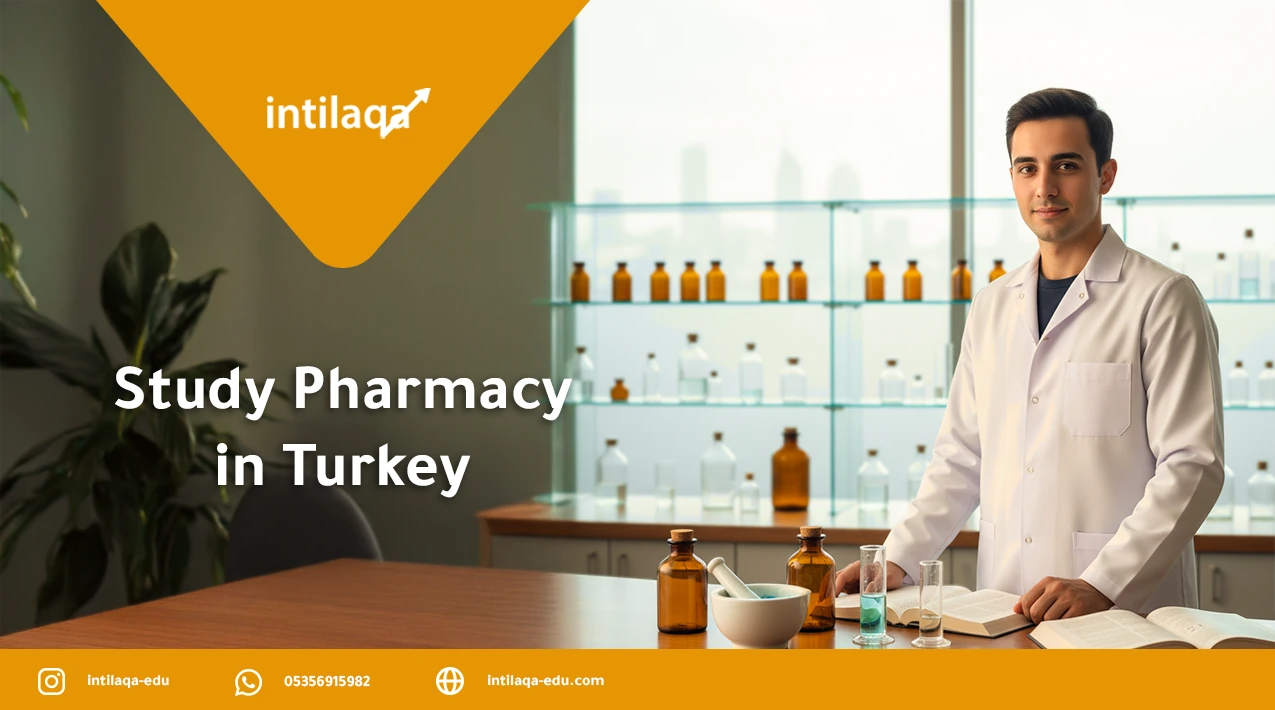
The decision to Study Pharmacy in Turkey is a strategic choice for students seeking high-quality medical education that combines European scientific rigor with intensive practical experience. With the significant renaissance in the Turkish pharmaceutical sector, private universities offer world-class programs in English, focusing on scientific research and advanced clinical training at competitive costs.
This article is your comprehensive guide to exploring all aspects of Studying Pharmacy in Turkey, starting from the study advantages and courses, to the costs and admission requirements for the Bachelor’s, Master’s, and PhD levels.
What is the Pharmacy Major?
The Pharmacy major is a fundamental pillar in the healthcare system, a science combining health, chemical, and biological sciences. This major focuses primarily on everything related to medication, from its discovery and development, through its manufacturing, analysis, and quality assurance, to dispensing it to patients and providing consultations to ensure its safe and effective use.
The pharmacist’s role is not limited to dispensing prescriptions, but they are the primary medication expert and direct health consultant to the community. To provide a deeper understanding, the axes of the Pharmacy major can be detailed in the following points:
Drug Discovery and Development:
Searching for new chemical and biological compounds that can be used as effective treatments for diseases.
Pharmaceutical Chemistry:
Studying the chemical structure of drugs and how to design and manufacture (synthesize) them.
Pharmaceutics:
The science of converting the active pharmaceutical ingredient into an appropriate dosage form (such as tablets, capsules, injections, or syrups) and ensuring its stability.
Pharmacology:
Understanding the drug’s mechanism of action inside the human body, how the body affects the drug (Pharmacokinetics), and how the drug affects the body (Pharmacodynamics).
Clinical Pharmacy:
Applying pharmacological knowledge directly in patient care, often within a medical team in hospitals, to monitor treatment plans and prevent drug interactions.
Drug Control and Quality Assurance:
Ensuring that manufactured drugs meet the highest standards of quality, safety, and efficacy before reaching the patient.
Advantages of Studying Pharmacy in Turkey
Turkish universities have become a prime destination for international students, and Studying Pharmacy in Turkey is at the forefront of preferred choices for students seeking high-quality education at competitive costs. This demand is due to a set of attractive advantages, most notably:
Quality of Academic Education:
Turkey possesses prestigious universities (public and private) with advanced international rankings. These universities adopt modern curricula aligning with European and American standards, focusing heavily on scientific research and drug development.
Broad International Recognition:
Most Turkish universities are recognized in the majority of Arab countries and the European Union. Turkey is also a member of the Bologna Process, meaning the degree follows European higher education standards, facilitating the pursuit of postgraduate studies or working abroad.
Competitive Tuition Costs:
Compared to universities in Europe and North America, the tuition fees to Study Pharmacy in Turkey are very reasonable and competitive, while maintaining an excellent educational standard.
Diversity of Study Languages:
Study is not limited to the Turkish language. The majority of private universities, and many major public universities, offer pharmacy study programs entirely in English, removing the language barrier for international students.
Advanced Practical Training:
Curricula focus on practical application. Universities possess modern and advanced laboratories, in addition to mandatory practical training opportunities (Internships – Staj) in hospitals, community pharmacies, and pharmaceutical companies, granting the student strong practical experience before graduation.
Rich Cultural and Living Environment:
Turkey features a safe and welcoming social environment for foreign students, with significant cultural and social affinity with the Arab region. This facilitates the adaptation and integration process for students.
What are the Courses for the Pharmacy Major in Turkey?
To obtain a Bachelor of Pharmacy (B.Pharm) degree in Turkey, the curriculum is built gradually and comprehensively, starting with basic sciences and delving into specialized and clinical pharmaceutical subjects.
The educational system in Turkey, aligned with the Bologna Process standards, aims to provide the student with a solid scientific foundation and strong practical experience.
Although course names may vary slightly from one university to another, the typical study plan for the Pharmacy program (B.Pharm or Pharm.D in some universities) includes the following axes:
First Year: Introductory Basic Sciences
- General and Analytical Chemistry: The foundation for understanding drug interactions.
- Pharmaceutical Physics: Applications of physics in the pharmaceutical field.
- Biology and Genetics: An introduction to life sciences.
- Mathematics and Biostatistics: Essential for data analysis and research.
- Language (English or Turkish): To develop academic skills.
- Introduction to Pharmacy: An overview of the profession and its history.
Second Year: Foundational Medical Sciences
- Pharmaceutical Organic Chemistry: Studying the compounds that form the basis of drugs.
- Anatomy: Understanding the structures of the human body.
- Physiology: Understanding how body organs function.
- Biochemistry: Studying chemical processes within living organisms.
- Microbiology and Immunology: Studying infections and immunity.
Third Year: Core of the Major (Basic Pharmaceutical Courses)
- Pharmacology I: The most important axis, beginning with studying how drugs affect the body.
- Pharmaceutics I: The science of converting the active ingredient into a dosage form (tablets, injections, etc.).
- Pharmaceutical Chemistry: Studying the relationship between the chemical structure of a drug and its efficacy.
- Pharmacognosy: Studying drugs extracted from natural sources (plants).
Fourth Year: Specialization and Clinical Sciences
- Clinical Pharmacology: Applying pharmacology to disease states.
- Toxicology: Studying the adverse effects of chemicals and drugs.
- Pharmaceutical Technology: Drug manufacturing techniques on an industrial scale.
- Clinical Pharmacy and Patient Care: The beginning of direct patient interaction.
- Pharmaceutical Biotechnology.
Fifth Year: Practice and Graduation
- Graduation Project: Scientific research supervised by a professor.
- Mandatory Practical Training (Internships – Staj): An intensive training period in several areas:
- Community Pharmacy.
- Hospital Pharmacy.
- (Sometimes optional) Pharmaceutical companies or laboratories.
- Pharmaceutical Ethics and Legislation.
- Advanced Elective Courses: Such as Cosmetology or Advanced Industrial Pharmacy.
How Many Years is the Study of Pharmacy in Turkey?
The duration to Study Pharmacy in Turkey is 5 years of study to obtain a Bachelor’s degree in Pharmacy.
This duration does not include the language preparatory year (whether English or Turkish), which the student may need if they do not possess a language proficiency certificate required by the university, thus making the total duration 6 years.
Studying a Master’s in Pharmacy in Turkey
The Master’s stage following the Bachelor of Pharmacy (the 5 years) is the advanced step for those wishing to deepen their academic path or specialize in precise pharmaceutical areas.
While the Bachelor’s degree provides the comprehensive foundation for practicing the profession, the Master’s is the point where the actual specialization phase begins. Private universities in Turkey offer world-class programs aimed at graduating specialized researchers or professional experts, providing them with deep scientific knowledge and advanced skills.
Program Types and Duration (With Thesis and Non-Thesis)
Studying a Master’s in Pharmacy majors in Turkey typically takes 2 years. Private universities offer the following two tracks with high flexibility:
1. Master’s with Thesis (Tezli):
-
- This track focuses on in-depth scientific research and preparing a scientific thesis.
- This option is ideal for students aspiring to pursue a PhD or work in the academic and research field and drug development.
2. Non-Thesis Master’s (Tezsiz):
-
- Yes, this track is common and available in private universities, and it is specifically designed for professionals and working pharmacists.
- It focuses on the applied and professional aspect, where the student completes intensive coursework and executes a graduation project (instead of a thesis).
- This track targets pharmacists seeking to enhance their expertise and secure a professional promotion in their field without committing to the academic research path.
Available Specialization Titles
At this stage, the student does not study “Pharmacy” in general, but chooses a specialized program. Private universities stand out in offering precise majors highly demanded in the job market. The most prominent of these majors include:
1. Academic and Research Majors (With Thesis):
- Pharmacology.
- Pharmaceutical Chemistry.
- Pharmacognosy.
- Pharmaceutical Technology.
- Toxicology.
2. Professional and Applied Majors (Non-Thesis):
These are the majors focused on by private universities to meet direct job market needs:
- Clinical Pharmacy: This is the most common major in the professional track (non-thesis) and is widely available in major private universities, often taught in English.
- Cosmetology: A highly demanded major that private universities excel at offering as a specialized Master’s program.
- Sports Pharmacy: A unique major and an excellent example of innovative professional programs that private universities have started offering.
Studying a PhD in Pharmacy in Turkey
The PhD stage in Pharmacy is the academic and research apex, coming after completing the Master’s with thesis. This stage targets students with a passion for deep scientific research and innovation, aiming to become research scientists or university professors.
Private universities in Turkey offer highly advanced infrastructure, including research labs equipped with the latest technologies and internationally experienced faculty, making it an ideal environment for studying a PhD.
Program Duration and Nature
Studying a PhD in Pharmacy majors in Turkey typically takes 4 years after the Master’s.
The program usually consists of:
1. First Phase (One to Two Years): Highly advanced and specialized coursework.
2. Second Phase (Two to Three Years): The Comprehensive Competency Exam (Yeterlilik), followed by full dedication to conducting scientific research and preparing the thesis.
PhD Research Specialization Titles
Specializations at the PhD level are more precise and focused, relying on conducting innovative research in university laboratories. The main research areas offered by private universities include:
1. PhD in Pharmacology:
Researching drug mechanisms of action at the molecular and cellular levels.
2. PhD in Pharmaceutical Chemistry:
Designing and developing new and innovative drug molecules.
3. PhD in Pharmaceutical Technology:
Inventing advanced drug delivery systems (such as nanotechnology).
4. PhD in Clinical Pharmacy:
Conducting clinical research to evaluate the efficacy and safety of therapeutic regimens.
5. PhD in Pharmacognosy:
Advanced research in discovering active compounds from natural sources and biotechnology.
6. PhD in Toxicology:
Assessing the risks and molecular mechanisms of toxins.
7. PhD in Cosmetology:
Research and development in safe and effective cosmetic formulations and ingredients.
Best Universities to Study the Pharmacy Major in Turkey
Private universities in Turkey are distinguished by providing advanced technological infrastructure, modern laboratories, and practical training opportunities in their own hospitals, making them an ideal environment to Study Pharmacy in Turkey.
Competition is fierce in this field, and a number of universities stand out as preferred choices for international students seeking high educational quality, often offering study in English. Among these prominent universities are:
- Biruni University
- Okan University
- Medipol University
- Lokman Hekim University
- Istinye University
- Bahcesehir University
- Aydin University
Cost of Studying the Pharmacy Major in Turkey
The cost to Study Pharmacy in Turkey depends on the university and the language of study. Since it is a medical major requiring advanced laboratories and practical training, the fees reflect the quality of the infrastructure.
Bachelor’s Level (Annually)
Being an applied medical major, the annual Bachelor’s tuition fees at private universities range approximately between $7,500 and $18,000, especially for programs offered in English.
Master’s Level (Full Program)
For Master’s programs, whether with thesis (Tezli) or non-thesis (Tezsiz), the average total cost for the full program is around $4,500.
PhD Level (Full Program)
As for research PhD programs in Drug Development and Advanced Sciences, the average tuition for the entire program is about $5,000.
Admission Requirements to Study the Pharmacy Major in Turkey
Admission requirements for the Pharmacy major in Turkey are considered relatively flexible at private universities, but they focus primarily on ensuring the student possesses the strong scientific foundations (especially chemistry and biology) necessary for success in this advanced medical field.
1. Bachelor’s Level
Admission at private universities relies mainly on the high school diploma, with an absolute preference for students from a scientific background.
- High School Diploma: Obtaining a good GPA (often above 70% as a minimum, which may rise depending on the university) is considered sufficient for admission.
- Academic Track: It is primarily required that the student is a graduate of the Scientific Track, given the major’s heavy reliance on chemistry, biology, and physics subjects.
- Transcripts: Showing the student’s grades throughout the high school years, translated and notarized.
- Proof of Language Proficiency: Certificate (TOEFL/IELTS) for studying in English, or (TÖMER) for Turkish. If a certificate is unavailable, the student can take a university exemption exam or study a language preparatory year.
- Core Documents: A copy of a valid passport and recent personal photos.
2. Master’s Level
Admission here focuses exclusively on the student’s pharmaceutical academic background.
- Bachelor’s Degree: The applicant must hold a 5-year Bachelor’s degree in Pharmacy. Master’s programs are precise majors (such as Clinical Pharmacy or Pharmacology) built upon a pharmaceutical foundation, so admission from other majors (like Chemistry or Biology) is almost impossible.
- University Transcript: Detailing all subjects the student studied during the Pharmacy Bachelor’s and their grades.
- Proof of Language Proficiency: A certificate proving the student’s proficiency in the teaching language (often English for precise majors), or passing the language preparatory year.
- Core Documents: A copy of a valid passport and recent personal photos.
3. PhD Level
Admission here requires a specialized academic and research background.
- Master’s Degree: The applicant must hold a Master’s degree in a precise pharmaceutical major (with Thesis – Tezli). Universities often require the applicant to have completed the research track of the Master’s to be eligible to pursue a PhD.
- Previous Major: The Master’s major must be related to the desired PhD program (e.g., a Master’s in Pharmaceutical Chemistry to apply for a PhD in the same field).
- Master’s Transcript: To evaluate the student’s academic and research performance.
- Proof of Language Proficiency: A certificate (TOEFL) or equivalent with a high score, as the language of scientific research in PhDs is often English.
Future of Pharmacy Graduates in Turkey
Graduates of the Pharmacy major in Turkey enjoy broad career prospects and a promising future, backed by one of the strongest healthcare and pharmaceutical markets in the region. Turkey is not just an excellent educational destination; it is a massive regional hub for manufacturing and exporting medicines, hosting the regional headquarters of major global pharmaceutical companies.
The graduate’s future is not limited to traditional work in community pharmacies. It extends to diverse and advanced sectors, especially for private university graduates who have acquired practical skills, training in modern hospitals and labs, and English language proficiency.
The most important professional and career paths include the following:
Pharmaceutical Industry:
- Research and Development (R&D): Working in laboratories to innovate and develop new drugs.
- Manufacturing and Quality Assurance (QC/QA): Supervising production lines in major factories and ensuring drugs meet global specifications.
- Regulatory Affairs: Working as a liaison for drug registration and obtaining Ministry of Health approvals.
- Marketing and Sales (Medical Rep): Working as scientific representatives for major pharmaceutical companies.
Hospitals and Healthcare Sector:
- Clinical Pharmacy: A rapidly growing field. The pharmacist works as part of the medical team inside hospitals (especially major private university hospitals) to monitor patient treatment plans and ensure medication safety.
Cosmeceuticals Sector:
- Turkey, and Istanbul in particular, is a pioneer in this field. Pharmacists holding postgraduate degrees in “Cosmetology” (a major offered by private universities) can work in developing and formulating medical and cosmetic products.
Academic and Research Path:
- Pursuing postgraduate studies (Master’s and PhD) and joining the teaching faculty in private or public universities, or working as researchers in specialized research centers.
Community Pharmacies:
- The traditional and most common path, which is working as responsible pharmacists in private pharmacies spread throughout Turkey.
How Do I Study Pharmacy in Turkey?
The application process to Study Pharmacy in Turkey is a clear and organized process. To ensure you secure a seat in this prestigious medical major, we recommend following these organized steps:
1. Choose the Right University
The Pharmacy major requires strong infrastructure and advanced laboratories. Let us help you compare private universities that have the best faculties of pharmacy, offer programs in English, and provide practical training (Staj) in their own hospitals.
2. Prepare Your Academic Documents
To start, you will need to prepare your application file. This includes: a translated and notarized copy of your high school diploma (strictly the Scientific Track), detailed transcripts, a copy of your passport, and recent personal photos.
3. Leave the Application to Us
To ensure your application is submitted correctly and avoid any mistakes, we submit your file to the target universities on your behalf. Our expertise in Pharmacy admission requirements guarantees you the fastest response.
4. Obtain Admission and Secure Your Seat
Shortly after, we will secure the “Initial Acceptance Letter” for you. To officially secure your seat in the Faculty of Pharmacy, you will pay an initial installment (Deposit) of the tuition fees directly to the university’s account, after which we will obtain the “Final Acceptance Letter” for you.
5. Obtain a Student Visa
This final letter is the official document you will need to head to the Turkish embassy or consulate in your country to obtain a student visa, an essential step before traveling.
6. Begin Your Journey as a Future Pharmacist!
Welcome to Turkey! Upon your arrival, we will receive you and accompany you to complete your official and final registration process at the university. After that, you will be ready to wear your white coat and start your academic journey in the Pharmacy major.
How Does the Intilaqa Team Help You?
The Intilaqa Educational Team works to assist you step-by-step to choose the most appropriate major and university for you in Turkey, according to your academic interests and study budget.
We offer you a comprehensive free consultation that includes:
- Recommending the best Turkish universities that teach your major.
- Clarifying available costs and scholarships.
- Full follow-up in the registration process until final acceptance.
Whether you plan to Study Pharmacy in Turkey or any other major, you can start by learning about the details of Studying in Turkey via our complete guide:
Study in Turkey