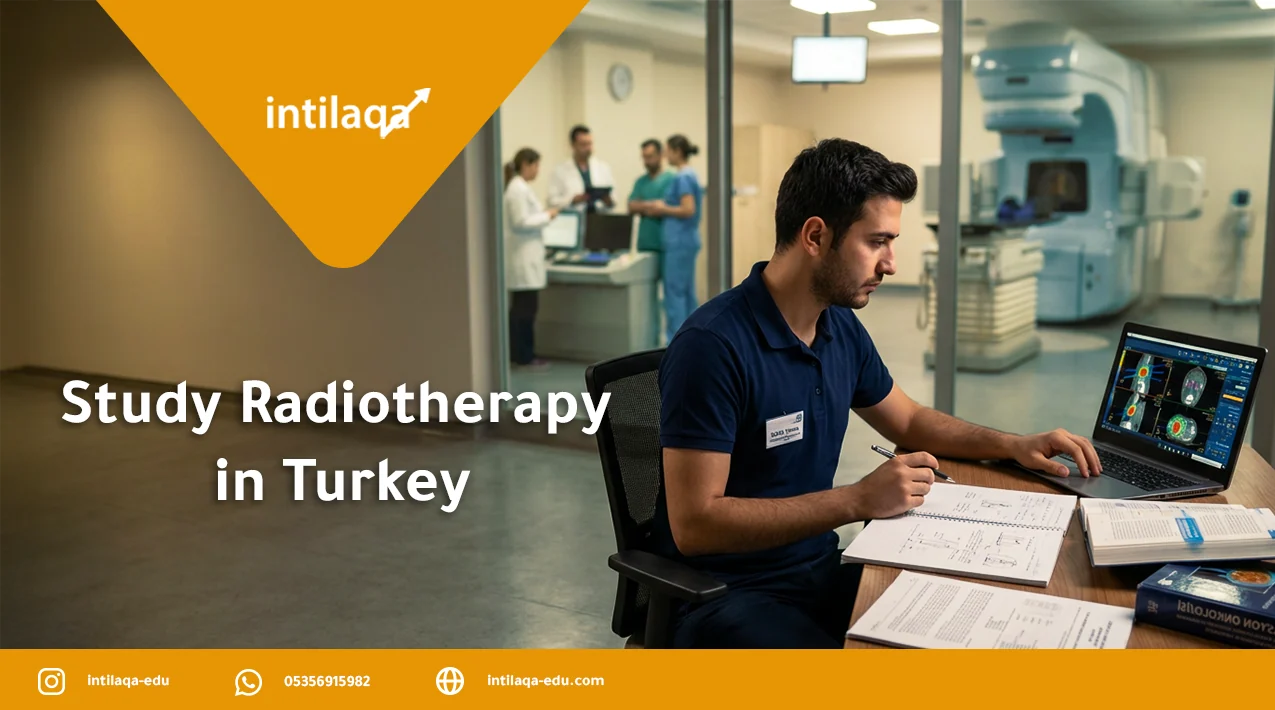
Radiotherapy is a cornerstone of modern oncology, combining technological precision with advanced medical care in the treatment of cancer. With the rapid technological development of hospitals and universities in Turkey, international students who want to study Radiotherapy in Turkey can pursue a focused diploma program that combines theoretical education with advanced clinical training in a relatively short period.
In this guide, you will find a complete overview of the program, from courses and top universities to tuition fees, admission requirements, career opportunities, and the future prospects of graduates in the healthcare sector.
What Is Radiotherapy?
Radiotherapy is a key field in modern medicine that combines medical science with advanced technology to treat cancer. When you choose to study Radiotherapy in Turkey through a diploma program, you learn more than how to operate equipment; you receive medical and technical training that prepares you to work as a Radiotherapy Technician alongside oncologists and medical physicists to carry out treatment plans accurately.
During this diploma program, students build a set of essential professional skills, including:
Medical and Anatomical Understanding:
Understanding the structure of the human body and the nature of tumors to help direct treatment accurately toward the affected area while minimizing exposure to healthy tissue.
Technical Competence:
Learning to operate complex radiotherapy equipment, including linear accelerators, while understanding the radiation physics principles behind their use.
Safety Protocols:
Following strict international radiation-protection standards to help protect both patients and healthcare professionals from unnecessary radiation exposure.
Patient Care:
Providing psychological and emotional support to patients and interacting with them professionally and compassionately during challenging treatment sessions.
Why Study Radiotherapy in Turkey?
In recent years, Turkish universities have become an attractive option for students interested in medical and technical fields, supported by advanced infrastructure and curricula designed around modern professional standards. Choosing to study Radiotherapy in Turkey through a diploma program can offer several academic and professional advantages, including:
Advanced Technological Infrastructure:
Radiotherapy depends heavily on technology, and Turkish universities, especially private institutions, provide modern simulation laboratories and advanced radiotherapy equipment comparable to technologies used in leading European hospitals, giving students practical exposure to contemporary systems.
Intensive Practical Training:
Many universities are connected with university hospitals and specialized oncology centers, giving students opportunities to experience real clinical environments and work with patient cases under medical supervision before graduation.
European Higher Education Framework:
Turkish universities follow the standards of the Bologna Process, supporting academic quality, broader degree recognition, and greater flexibility when transferring credits or continuing studies in Europe.
Short and Intensive Study Period:
As a two-year diploma program, Radiotherapy allows students to enter a specialized healthcare field more quickly without spending many additional years in primarily theoretical study.
Affordable Tuition Fees:
Compared with many European countries and the United States, tuition fees for this field in Turkey are relatively affordable while maintaining a strong standard of education.
Flexible Language Options:
Many universities offer programs in English as well as Turkish, reducing the language barrier for international students and helping them become familiar with internationally used medical terminology.
Radiotherapy Diploma Courses in Turkey
The curriculum you follow while studying Radiotherapy in Turkey through a diploma program is designed to take students from basic medical foundations to specialized technical skills. Courses gradually progress from general medical subjects to applied radiotherapy training.
The following are some of the main courses commonly taught in Turkish universities and vocational schools offering this program:
Year One: Medical Foundations
The first year focuses on building a strong foundation in medical sciences and the fundamentals of the profession:
- Radiation Physics: Understanding the nature of radiation, how it is generated, and its physical properties.
- Anatomy & Physiology: Studying the body’s organs, their locations, and their functions, which is essential for accurately identifying tumor locations.
- Medical Terminology: Learning the core terminology used for communication in hospitals and healthcare settings.
- Introduction to Radiotherapy: General principles covering the history and development of the field.
- Radiation Safety and Protection: International safety standards designed to protect patients and technicians from incorrect or unnecessary radiation exposure.
Year Two: Specialization and Practical Application
In the second year, students move deeper into the specialty and advanced treatment techniques:
- Radiotherapy Techniques: An in-depth study of how different devices, such as linear accelerators, are used to treat different types of cancer.
- Clinical Oncology: Studying the behavior of cancer cells, how they spread, and how treatment affects them.
- Medical Imaging for Radiotherapy: Learning how CT and MRI images are used in treatment planning.
- Radiobiology: Studying the biological effects of radiation on healthy and diseased living cells.
- Compulsory Summer Internship: A practical training period in hospital oncology departments where students apply what they have learned in a clinical setting.
How Long Does It Take to Study Radiotherapy in Turkey?
The official duration of the Radiotherapy diploma is two academic years, divided into 4 semesters.
If a student does not meet the required proficiency level in the language of instruction, whether Turkish or English, an additional language preparatory year may be required, bringing the total study period to 3 years.
Best Universities to Study Radiotherapy in Turkey
Choosing the right university is an important part of your plan to study Radiotherapy in Turkey because the program requires practical training with advanced and highly sensitive medical equipment. The following universities are among the notable options for this program:
Uskudar University:
Uskudar University has a strong focus on health and behavioral sciences. For Radiotherapy students, the university provides advanced simulation laboratories within its Vocational School of Health Services, allowing students to practice patient positioning and treatment-planning procedures in a controlled environment before moving into hospital settings.
Istanbul Medipol University:
Istanbul Medipol University stands out for its practical training environment through the Medipol Mega University Hospital Complex. Radiotherapy students can gain direct exposure to modern linear accelerators and technologies such as CyberKnife and Gamma Knife available within the university’s hospital network, helping them build practical familiarity with advanced treatment equipment before graduation.
Istinye University:
Istinye University is academically connected with the Medical Park and Liv Hospital groups, among Turkey’s major healthcare networks. This relationship gives Radiotherapy students access to clinical training opportunities in oncology centers within these hospital systems and exposure to experienced oncology professionals.
Bahcesehir University:
Bahcesehir University offers education through its Vocational School of Health Services with a strong academic and professional focus. Its Radiotherapy program emphasizes technical knowledge and language skills while providing training opportunities through affiliated hospital networks, preparing graduates for professional environments in Turkey and abroad.
Biruni University:
Biruni University specializes in health sciences, with substantial academic resources directed toward medical education and laboratories. Its Radiotherapy program places strong emphasis on practical coursework, supported by anatomical models and training equipment designed to simulate real clinical environments.
Istanbul Beykent University:
Istanbul Beykent University places strong emphasis on applied and vocational education. Radiotherapy students are trained in university laboratories with a focus on workplace readiness, safety protocols, and the correct handling of radiotherapy equipment.
Cost to Study Radiotherapy in Turkey
Affordable tuition is one of the main factors attracting international students to private universities in Turkey. When planning to study Radiotherapy in Turkey, tuition fees vary depending on the university and the language of instruction, with English-taught programs generally costing more than Turkish-taught programs.
In general, annual tuition fees for this program at private universities range from $1,400 to $4,500.
Lower Range (around $1,400 – $2,000): These fees are often associated with Turkish-taught programs or universities offering scholarships and special discounts for advance payment.
Upper Range (up to $4,500): These fees are generally associated with English-taught programs or universities with higher rankings and large medical complexes.
Requirements to Study Radiotherapy in Turkey
One of the main reasons international students choose to study Radiotherapy in Turkey is the relatively flexible admission process. To apply for a place in this diploma program, students generally need to meet the following basic requirements:
1. High School Diploma:
The main requirement is a high school diploma from a track that qualifies the student for health-related programs. At private universities, an average of 50% or above is often sufficient for admission to the program.
2. No YOS/SAT Requirement:
Unlike many public universities, private universities generally do not require international students applying to diploma programs to submit YOS or SAT scores, with admission primarily based on the high school diploma.
3. Language Requirement:
Whether you choose a Turkish- or English-taught program, you will need to demonstrate proficiency in the language of instruction. If you do not have an accepted language certificate, the university may require you to take its proficiency or exemption exam. Students who pass can begin the program directly, while those who do not may need to complete a language preparatory year.
4. Required Registration Documents:
- A copy of a valid passport.
- The original high school diploma, translated and certified.
- The academic transcript, translated and certified.
- A recent biometric photo.
Career Prospects After a Radiotherapy Diploma in Turkey
With growing health awareness and the expansion of specialized oncology treatment centers, the career outlook for this field is promising. After studying Radiotherapy in Turkey and completing the diploma, graduates can pursue specialized technical roles within the healthcare sector.
Graduate opportunities can be divided into two main paths:
1. Professional Path (Career Areas):
As a Radiotherapy Technician (Radyoterapi Teknikeri), graduates may work across a range of healthcare institutions, including:
- Oncology Units in Public and Private Hospitals: Operating treatment equipment and supporting patient follow-up during radiotherapy procedures.
- Specialized Radiotherapy Centers: Centers focused specifically on cancer treatment.
- Research and University Centers: Participating in research related to the development of treatment technologies.
- Medical Equipment Companies: Working as an application specialist or trainer for modern radiotherapy equipment.
2. Academic Path (DGS Vertical Transfer Exam):
Turkey provides diploma graduates with the option to take the Vertical Transfer Exam (DGS). Students who aim to earn a bachelor’s degree may use this route to continue in related fields for an additional two years, such as:
- Nursing (Hemsirelik).
- Emergency and Disaster Management.
- Health Management.
This means the diploma can also serve as a first step toward further academic and professional development.
How to Study Radiotherapy in Turkey?
To complete the application process and begin studying Radiotherapy in Turkey through a diploma program in an organized way, follow these practical steps:
1. Choose the Right University
With several universities offering different tuition fees and study environments, the first step is to choose the institution that fits your budget and academic goals. The Intilaqa team can help identify universities where places are still available and guide you toward suitable options.
2. Prepare the Required Documents
To begin the application, prepare clear digital copies of the main documents: your high school diploma, academic transcript, both translated and certified, and a copy of your passport.
3. Apply for Free Through Intilaqa
Instead of applying independently, Intilaqa can submit your file to the university officially and free of charge, helping streamline the preliminary admission process and giving you access to available tuition discounts for international students.
4. Pay the Fees and Confirm Your Seat
Once the preliminary acceptance letter is issued, universities require the first tuition payment to be transferred directly to their bank account. This step is necessary to convert the preliminary acceptance into final admission and officially secure your seat.
5. Apply for a Student Visa
After receiving the final acceptance document, you should apply for a student visa through the Turkish embassy or consulate in your country. This is the official document required to enter Turkey for study purposes.
6. Arrive and Complete Final Registration
After arriving in Istanbul, you can complete final registration through the university’s student affairs office, submit the original documents, and receive your student ID before beginning classes.
How Can the Intilaqa Team Help You?
The Intilaqa Education team supports you step by step in choosing the program and university in Turkey that best fit your academic interests and study budget.
We provide a comprehensive free consultation that includes:
- Recommending suitable Turkish universities offering your chosen program.
- Explaining tuition fees and available scholarship opportunities.
- Providing full support throughout the application process until final admission.
Whether you plan to study Radiotherapy in Turkey or pursue another program, you can learn more about studying in Turkey through our complete guide:
Study in Turkey