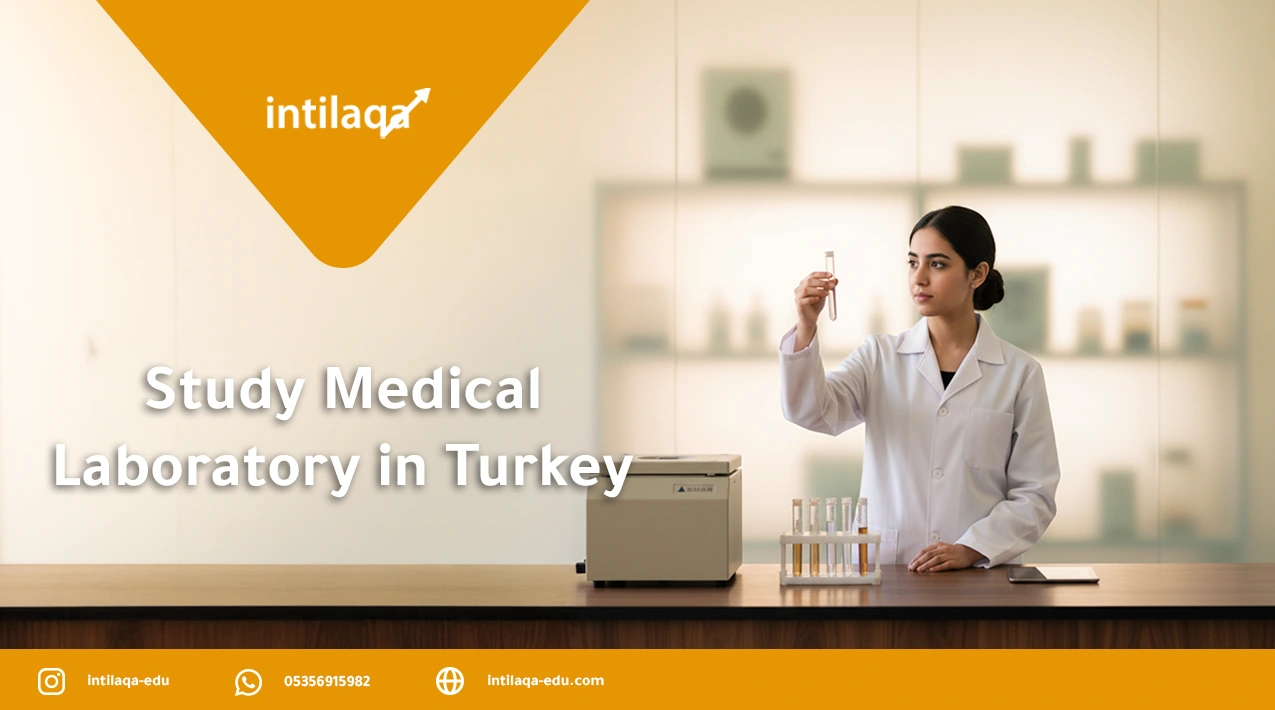
If you’re planning to study Medical Laboratory in Turkey, you’re choosing one of the most popular medical programs among international students — Turkish universities stand out in teaching it, offering up-to-date curricula, training labs, and hospitals that give students the preparation they need to excel in the job market.
In this article, the Intilaqa team walks you through everything about the experience of studying Medical Laboratory in Turkey — from its advantages and the best universities and their fees, to admission requirements and the enrollment process, step by step.
Keep reading to get the latest information to support you in making the right decision for you.
What Is Medical Laboratory?
Medical Laboratory is one of the fundamental pillars of the healthcare system and modern medicine. It can be thought of as the “hidden eye” that helps doctors see, with extreme precision, what’s happening inside a patient’s body — the scientific bridge that connects clinical symptoms to a confirmed diagnosis.
This program focuses on giving students deep theoretical knowledge and intensive practical skills needed to carry out a wide range of tests and analyses on biological samples. These samples include:
- Blood
- Various body fluids (such as urine, cerebrospinal fluid)
- Tissue
Graduates of this program analyze these samples using the latest equipment and techniques to detect diseases, identify their causes (whether bacterial, viral, or parasitic), measure biological markers (such as hormone, sugar, and lipid levels), and monitor treatment effectiveness.
In short, medical laboratory specialists play a vital, indispensable role — estimates suggest that around 70-80% of medical decisions (whether in diagnosis, treatment, or prevention) rely directly on the accurate results a lab provides.
Benefits of Studying Medical Laboratory in Turkey
Medical Laboratory in Turkey is one of the preferred choices for international students, as Turkish universities stand out in teaching it across several dimensions, including:
Quality of Education
Turkish universities follow advanced curricula that rival European universities, ensuring a high-quality level of education in the program.
Experienced Teaching Staff
Courses are taught by specialized professors who combine academic knowledge with field experience, enriching the learning process.
Comprehensive Training
Turkish universities provide modern labs and comprehensive clinical and practical training opportunities in their university hospitals, covering every aspect of medical testing.
Professional Preparation
The program focuses on equipping students with the technical skills needed to enter the local and international job market right away.
Student Exchange Opportunities
Most Turkish universities are members of the Erasmus program, which offers the chance to study or train at partner European universities, broadening students’ academic and cultural horizons.
Personal Development
Studying in Turkey offers a culturally rich, international environment that strengthens students’ communication skills, flexibility, and adaptability. Turkish universities also offer diverse student clubs that develop students’ skills outside the formal curriculum.
Lower Tuition Fees
Compared to other developed countries, tuition fees at Turkish universities are reasonable — an important advantage for international students.
What Will You Study in Medical Laboratory in Turkey
The Medical Laboratory Technician program in Turkey focuses on giving students a full set of applied skills. Because of that, you’ll study:
1. Core and Specialized Courses
These courses focus on giving you the scientific background and practical skills needed to perform your duties in the lab:
- Clinical Biochemistry: The study of tests related to biological fluids and their components, such as measuring blood sugar, lipids, and kidney and liver function.
- Hematology: Covers the study of blood components, complete blood count (CBC) analysis, and identifying anemia and other blood disorders.
- Medical Microbiology: The study of bacteria, viruses, and fungi, and how to isolate and culture them and test their sensitivity to antibiotics.
- Histology and Cytology: An introduction to preparing tissue and cell slides and examining them under a microscope to support diagnosis.
- Immunology: The study of immune system reactions and serological tests related to antibodies and immune-related diseases.
- Basic Physiology and Anatomy: Builds a foundational understanding of how the human body and its vital systems function.
2. Practical and Training Courses (Hands-On Application)
The most important part of the associate degree program is intensive hands-on training, which focuses on:
- Basic Lab Techniques: Learning how to use lab tools and equipment, and how to prepare samples and solutions.
- Quality Control: Skills for ensuring the accuracy and validity of lab test results.
- Laboratory Safety: The procedures and rules needed to work safely in a lab environment.
- Mandatory Internship: Students complete a mandatory period at hospital or health center labs to gain direct hands-on experience under supervision.
How Many Years Does It Take to Study Medical Laboratory in Turkey
Medical Laboratory in Turkey is an associate degree program lasting two years, after which the student graduates as a certified lab technician, qualified to work in a wide range of labs — whether in hospitals, medical centers, or research centers.
If you need to learn the language, the university gives you a full year to learn Turkish, since it’s the only language of instruction for this program — which extends the total study duration to 3 years.
Best Universities for Studying Medical Laboratory in Turkey
Most Turkish universities offer a Medical Laboratory associate degree. Here are some of the best universities for studying it at the highest level:
1. Istanbul Aydin University
Aydin University stands out for adopting the latest teaching methods and modern programs, and it places strong emphasis on health-related programs.
It holds SABAK accreditation for several of its health science programs, ensuring education quality that meets international standards.
It’s ranked among the leading universities for teaching medical programs, with a strong focus on combining theoretical knowledge with hands-on practice.
2. Uskudar University
Uskudar University is known for its strong focus on brain science, neuroscience, and cognitive medicine, and it has excellent medical infrastructure.
It offers hands-on training at NPISTANBUL Hospital (the second brain hospital in Europe), providing a unique and advanced practical experience, especially in neurological and genetic testing.
It has advanced labs and research centers that support in-depth research in the field.
3. Istinye University
Istinye University stands out for its strong ties to major healthcare institutions and its focus on preparing students for the job market early on.
It offers intensive training and hands-on practice opportunities in hospital settings from the very first years, ensuring lab technicians are trained to enter the medical field directly. It’s considered one of the best Turkish universities for students looking to enter the job market quickly and with good pay.
4. Biruni University
Biruni University is primarily specialized in health and medical sciences, and it has its own hospitals and labs.
It’s considered the best university for studying Medical Laboratory because it’s a university specialized in the health field — its labs and hospitals are equipped with the latest advanced equipment and technology, ensuring advanced hands-on application of theoretical knowledge.
5. Bahcesehir University (BAU)
Bahcesehir University is known for its strength in linking education to the job market and offering a variety of professional training opportunities.
It prepares its students for the job market by focusing on training programs and diverse hands-on opportunities, ensuring they gain the experience required by major companies and institutions. Its location in Istanbul and its academic reputation open up wide employment prospects after graduation.
6. Medipol University
Medipol University is one of the strongest healthcare groups in Turkey, thanks to its wide network of hospitals and medical centers. It aims to train lab technicians capable of performing tests in clinical biochemistry, microbiology, pathology, and molecular biology and genetics — covering a broad specialization scope. Hands-on training takes place at the hospitals and labs of the university’s large affiliated medical group.
7. Atilim University
Atilim University is one of the strongest private universities in Ankara, with massive research infrastructure supporting applied sciences. It has strong research infrastructure that includes 170 labs and workshops, ensuring hands-on training in an advanced scientific environment. Its recent opening of new complexes for the Faculty of Medicine and Faculty of Health Sciences reflects its vision of providing quality education in the health field.
8. Atlas University
Atlas University is one of the newer universities focused on health sciences, with fully equipped labs.
It gives its students real-world work experience through multidisciplinary labs and clinical practice courses at Atlas University Hospital, blending education with real hands-on application.
It focuses on labs covering histology, embryology, and medical biology, giving students in-depth experience in vital branches of lab work.
Evening Study Options for Medical Laboratory in Turkey
To make things easier for students who prefer studying in the evening, some private Turkish universities offer an evening-schedule option for this program, namely:
- Isik University: $1,800/year.
- Topkapi University: $2,000/year.
Cost of Studying Medical Laboratory in Turkey
Tuition fees for Medical Laboratory in Turkey range from $1,300 to $12,000 per year, and fees vary from one university to another. Here’s a table we’ve put together showing Medical Laboratory fees at private Turkish universities for 2026:
| University | Language | Annual Fee |
|---|---|---|
| Kent University | TR | $1300 |
| Topkapi University | TR | $1450 |
| Yeni Yuzyil University | TR | $1500 |
| Isik University | TR | $1800 |
| Beykent University | TR | $1905 |
| Nisantasi University | TR | $1950 |
| Fenerbahce University | TR | $2000 |
| Okan University | TR | $2250 |
| Ankara Medipol University | TR | $2250 |
| Altinbas University | TR | $2500 |
| Arel University | TR | $2500 |
| Antalya Bilim University | TR | $2600 |
| Atlas University | TR | $2610 |
| Gelisim University | TR | $2750 |
| Uskudar University | TR | $2800 |
| Aydin University | TR | $3000 |
| Istanbul Medipol University | TR | $3500 |
| Bahcesehir University Istanbul | TR | $3500 |
| Biruni University | TR | $4500 |
| Istinye University | TR | $5000 |
| Atilim University | TR | $12000 |
Admission Requirements for Medical Laboratory in Turkey
Admission requirements for this program in Turkey are easy and within reach for all students — enrollment is possible with a 50% high school average, and private Turkish universities don’t require any admission exams such as YOS or SAT.
Public universities, on the other hand, require a high school average above 75%, along with passing the YOS or SAT exam (depending on the university), plus a high overall grade.
Documents Required to Enroll in Medical Laboratory in Turkey
- High school diploma with a translated and consulate-certified copy
- School transcript with a translated and certified copy
- Copy of a valid passport (information page)
- Turkish language test result (TOMER) at B2 level or higher (if available), or you’ll take a placement test — based on the result, you either begin your studies directly or are required to complete the prep year
- YOS exam result meeting the required score (for public university enrollment only)
Career Prospects for Medical Laboratory Graduates in Turkey
The career outlook for graduates of this program is good and stable, given the vital role lab technicians play in Turkey’s growing healthcare sector.
Graduates of this associate degree enjoy wide, in-demand job opportunities in Turkey:
- Hospitals and Clinics: Working in testing departments within public and private hospitals and large medical centers.
- Private Labs: Working at independent medical testing lab chains (such as urine, blood, and biochemistry labs).
- Research Centers: Assisting with tests and research at university labs or scientific research centers.
- Pharmaceutical Industry: Working in quality control or production units at pharmaceutical and medical supply factories.
- Regional Job Market: The Turkish qualification is recognized in many countries, opening up opportunities to work abroad.
A Quick Note
There’s currently a shortage of lab technicians in many parts of Turkey, which means job opportunities are growing faster than average.
Wages earned by lab technicians in Turkey are also reasonably good — starting at 25,000 Turkish lira, and rising especially when working in the private sector or major hospitals. Wages vary based on:
Experience: Wages rise noticeably with years of experience and specialized expertise.
Workplace: Wages at private hospitals and large labs in major cities (such as Istanbul, Ankara, and Izmir) tend to be higher.
How to Study Medical Laboratory in Turkey
You can easily apply for Medical Laboratory in Turkey by following these steps, in order:
1. Get Educational Consulting
Make sure you choose the right university with guidance from one of Intilaqa’s advisors, especially when it comes to recognition and your budget.
2. Prepare the Required Documents
Make sure your documents are complete with nothing missing, translated by a certified translator, and certified by the Turkish consulate.
3. Submit Your Application
You can do this step yourself through the university’s official website, or have the Intilaqa team handle the entire enrollment process on your behalf for free.
4. Wait for a Response
Turkish universities typically take at least 3 days to respond with either acceptance or rejection.
5. Secure Your Application
Once accepted, you’ll receive a preliminary acceptance letter, conditional on paying part of the program fee to secure your application and get your final acceptance.
6. Prepare to Travel
Using your final acceptance letter, you can apply for a student visa to Turkey, then complete final registration yourself and pay the remaining fees according to the payment plan, and begin your studies.
In the end, studying this associate degree in Turkey is a smart move — it gives you fast, practical qualifications (just two years of study) and secures stable job opportunities in a vital sector.
So if you’re thinking about studying in Turkey, Medical Laboratory is one of your best options. Don’t miss your chance — secure your university admission with the Intilaqa team.
How Can the Intilaqa Team Help You?
The Intilaqa Education team works step by step to help you choose the program and university that best fit you in Turkey, based on your academic interests and study budget.
We offer a comprehensive free consultation that includes:
- Recommending the best Turkish universities that teach your chosen specialty.
- Explaining the costs and available scholarships.
- Full follow-up throughout the registration process, all the way to final acceptance.
Whether you’re planning to study Medical Laboratory or any other program, you can start by learning more about studying in Turkey through our complete guide: