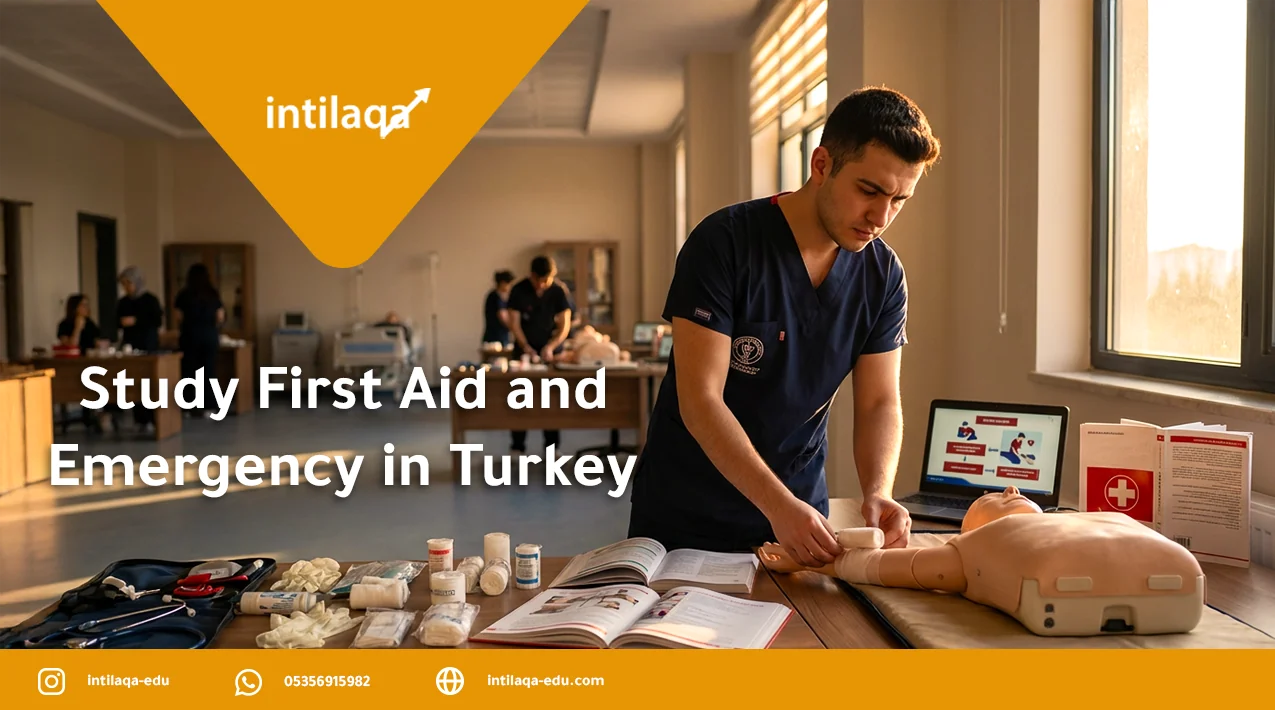
The Paramedic plays a central role in urgent medical response, where the outcome for injured patients can depend on the speed and quality of intervention. With the continued development of emergency medical services in Turkey, choosing to study First Aid and Emergency in Turkey offers strong practical value. This two-year diploma program is designed to move students from the classroom directly into real emergency settings through intensive training in ambulances and hospital emergency departments.
What Is First Aid and Emergency?
This program is academically known as First Aid and Emergency and is a two-year vocational diploma designed to prepare Emergency Medical Technicians, commonly referred to internationally as Paramedics.
The field is a core part of disaster medicine and pre-hospital care. Students do not simply learn how to apply bandages; they train in advanced medical procedures used to protect life during the critical first minutes after an injury or emergency.
The main responsibilities of graduates include:
Rapid Intervention and Scene Assessment:
Reaching the emergency scene quickly, assessing the environment for safety, and performing triage to prioritize critically injured patients.
Advanced Life Support (ALS):
Applying advanced CPR protocols, securing the airway with medical equipment, and using a defibrillator when required during cardiac emergencies.
Trauma and Injury Management:
Controlling severe bleeding, stabilizing fractures, protecting the spine from unnecessary movement, and responding to emergencies such as burns, drowning, stroke, and heart attacks.
Safe Transport and Monitoring:
Continuously monitoring the patient’s vital signs inside the ambulance and transferring the patient to the hospital emergency department in the most stable condition possible while providing the receiving medical team with a clear report of the interventions performed.
In short, a Paramedic brings emergency medical care directly to the patient before arrival at the hospital.
Why Study First Aid and Emergency in Turkey?
Turkey has a highly developed national emergency-response system, which makes the decision to study First Aid and Emergency in Turkey a field-based educational experience rather than a purely theoretical one. Key advantages include:
Ambulance-Based Training:
Turkish universities provide fully equipped training ambulances on campus, allowing students to practice working in confined spaces and under the pressure of a moving emergency environment before graduation.
Opportunity to Continue to a Bachelor’s Degree (DGS):
Diploma graduates can take the Vertical Transfer Exam (DGS) and continue toward a bachelor’s degree in fields such as Emergency and Disaster Management or Nursing. Students may complete only two additional years rather than starting again from the first year.
Disaster Simulation Laboratories:
Students train in scenarios that simulate natural disasters and mass casualty incidents, learning how to perform triage and manage emergencies under pressure.
Internationally Oriented Emergency Protocols:
Emergency medicine training in Turkey follows internationally used emergency-care principles and protocols, including approaches associated with organizations such as the American Heart Association (AHA), helping students build skills that are relevant across different healthcare systems.
Affordable Tuition:
Despite the cost of practical medical training equipment, tuition fees for this diploma at private universities in Turkey remain relatively affordable compared with many other healthcare programs.
First Aid and Emergency Courses in Turkey
The curriculum for studying First Aid and Emergency in Turkey is highly intensive and practical, with the goal of preparing students to act professionally under significant pressure. Courses are generally divided across two academic years as follows:
Year One: Medical and Scientific Foundations
The first year focuses on building a theoretical medical foundation and understanding how the human body functions.
- Anatomy & Physiology: Understanding body structure and the functions of vital organs such as the heart, lungs, and brain.
- Pharmacology: Studying emergency medications, pain relievers, and shock-related drugs and how they may be administered in emergency settings.
- Fundamentals of First Aid: Managing wounds, burns, and basic fractures.
- Cardiopulmonary Resuscitation (CPR): Intensive training in techniques used to restore circulation and breathing.
- Medical Terminology: Learning standardized terminology used when communicating with emergency physicians and hospital teams.
Year Two: Advanced Emergency Medicine and Practice
Students move into more complex emergency scenarios and field training.
- Emergency Medical Services: Learning how to manage an emergency scene, use radio communication, and follow transport protocols.
- Advanced Life Support (ALS): Using defibrillators and advanced airway-management techniques, including intubation.
- Trauma Management: Managing major traffic accidents, falls from height, internal bleeding, and other severe injuries.
- Physical Fitness: A compulsory subject at some universities to help ensure students can safely move patients and carry heavy equipment.
- Compulsory Internship: Real shifts in ambulances and hospital emergency departments.
How Long Does It Take to Study First Aid and Emergency in Turkey?
The official duration to study First Aid and Emergency in Turkey is only two academic years (4 semesters). The program is offered through vocational health schools and leads to an Associate Degree.
The duration may extend to 3 years if the student does not meet the Turkish-language proficiency requirement. In that case, a language preparatory year is completed before the two-year professional program.
Best Universities to Study First Aid and Emergency in Turkey
Turkish universities provide training environments that closely simulate real emergency situations through training ambulances and advanced emergency laboratories. The following are some of the universities recommended for students planning to study First Aid and Emergency in Turkey:
Istanbul Medipol University:
Istanbul Medipol University stands out for its strong healthcare infrastructure. It is the only private Turkish university among the listed options offering the First Aid and Emergency program in English, while also giving students access to practical training through the Medipol Mega medical complex.
Istinye University:
Through its relationship with major healthcare groups such as Medical Park and Liv Hospital, Istinye University provides students with access to practical emergency training across a broad hospital network.
Biruni University:
Biruni University has a strong focus on health sciences and provides emergency and disaster simulation laboratories that help students train for high-pressure scenarios.
Istanbul Gelisim University:
Istanbul Gelisim University offers health-related vocational education supported by simulation workshops and advanced training mannequins designed to reproduce realistic emergency responses.
Istanbul Topkapi University:
Istanbul Topkapi University is a relatively affordable option in Istanbul and places strong emphasis on direct practical training and the hands-on skills required in emergency medical work.
Cost to Study First Aid and Emergency in Turkey
The cost to study First Aid and Emergency in Turkey is relatively affordable compared with many other medical and healthcare programs. The following table shows the stated annual tuition fees at selected private universities:
| University | Language of Instruction | Annual Tuition Fee |
| Istanbul Topkapi University | Turkish | 1,450$ |
| Nisantasi University | Turkish | 1,950$ |
| Istanbul Gelisim University | Turkish | 2,558$ |
| Istanbul Medipol University | Turkish | 3,150$ |
| Istanbul Medipol University | English | 3,600$ |
| Biruni University | Turkish | 4,500$ |
| Istinye University | Turkish | 5,000$ |
Requirements to Study First Aid and Emergency in Turkey
Private Turkish universities generally follow flexible admission policies for international students applying to this diploma and do not require complex entrance exams such as YOS or SAT.
To gain admission and study First Aid and Emergency in Turkey, students generally need to meet the following basic requirements:
1. High School Diploma:
Applicants from science, humanities, or vocational high school tracks may apply, although science backgrounds are generally preferred because of the medical nature of the curriculum. A basic passing high school average, usually 50% or above, is generally sufficient for admission to many private universities.
2. Language Requirement:
Because most programs are taught in Turkish, with Istanbul Medipol University listed as an English-taught exception, students are encouraged to provide a TOMER certificate if available. Without one, they generally take the university’s exemption or proficiency exam, and those who do not pass complete a language preparatory year before beginning the program.
3. Documents Required for Preliminary Registration:
To open an application file and reserve a place, prepare clear scanned copies of the following documents:
- A copy of a valid passport.
- A copy of the high school diploma.
- Academic transcript, translated and certified.
- A personal photo with a white background.
Is a First Aid and Emergency Diploma Worth It?
This field offers a relatively short route into an essential healthcare profession: short study duration (two years) + relatively low tuition = faster entry into the job market.
Paramedics are not limited to ambulance work. Career paths can include:
National Emergency Medical Services (112):
Working as a Paramedic in public or private ambulances, one of the most common career paths.
Emergency Departments (ER):
Working in hospital triage areas, receiving critical patients, and supporting resuscitation alongside emergency physicians.
Occupational Health and Safety (OSGB):
Working in factories, construction sites, and large companies where on-site emergency medical personnel may be required under applicable occupational health and safety rules.
Search and Rescue Teams (AFAD & NGOs):
Working with government and non-governmental organizations in disaster zones and humanitarian emergencies.
Academic Path (DGS):
Graduates who want to continue their education may pursue related bachelor’s programs such as Nursing or Emergency and Disaster Management through the DGS pathway, subject to the applicable transfer rules.
How to Study First Aid and Emergency in Turkey
To begin your plan to study First Aid and Emergency in Turkey in an organized way, follow this practical roadmap for choosing a vocational health school with strong simulation and field-training facilities:
1. Choose the Right University
Do not base your decision on the university name alone. Make sure the institution provides emergency simulation laboratories and training ambulances. The Intilaqa team can help you compare universities based on training quality and tuition fees that fit your budget.
2. Prepare Your Application Documents
Prepare your documents early to save time. The main requirements are a translated and certified high school diploma, academic transcript, valid passport, and a personal photo.
3. Application and Admission
The Intilaqa team can manage the application process on your behalf free of charge. We review your file, recommend suitable programs based on your academic profile, and handle the application while helping you access available tuition discounts and partial scholarships.
4. Confirm Preliminary Enrollment
After receiving preliminary acceptance, you need to transfer the first tuition payment to the university’s official bank account to secure your place and receive the final acceptance document.
5. Apply for a Student Visa
Using the final acceptance document, apply for a student visa through the Turkish embassy or consulate in your country. This step is required for legal entry and study in Turkey when a visa is applicable to your nationality.
6. Arrive and Begin Your Studies
After arriving in Turkey, visit the university’s student affairs office to submit the original documents, complete final registration, receive your student ID, and begin the program.
How Can the Intilaqa Team Help You?
The Intilaqa Education team supports you step by step in choosing the program and university in Turkey that best match your academic interests and study budget.
We provide a comprehensive free consultation that includes:
- Recommending suitable Turkish universities that offer your chosen program.
- Explaining tuition fees and available scholarship opportunities.
- Providing full support throughout the application process until final admission.
Whether you plan to study First Aid and Emergency in Turkey or pursue another program, you can learn more about studying in Turkey through our complete guide: